


Page 1811 - Hall et al (2015) Principles of Critical Care-McGraw-Hill
P. 1811
1280     PART 11: Special Problems in Critical Care


                   CHAPTER   Dermatologic Conditions                   layers of the skin. Preparing the skin for invasive procedures with topi-
                                                                       cal solutions exposes the patient to potential sensitizers. Metabolically
                  129        Juliana L. Basko-Plluska                  active cells in the suprabasal layers are susceptible to inflammatory
                                                                       and cytotoxic reactions from medications and toxins. Disruption
                             Rekha Vij
                             Aisha Sethi                               in cell adhesion clinically manifests as blisters and may result from
                                                                       medications, toxins, pressure, extremes in temperature, or autoimmune
                                                                       diseases. Infections and inflammatory processes can occur at any level
                                                                       or in any structure, leading to conditions such as impetigo, folliculitis,
                  KEY POINTS
                                                                       cellulitis, fasciitis, or vasculitis.
                     • In a patient with a dermatologic condition, observation and     ■
                    description of the lesions (morphology, distribution, and texture)   BASIC MORPHOLOGIC APPROACH AND DESCRIPTIONS
                    are important for developing a differential diagnosis.  When approaching a patient with skin disease, careful observation,
                     • Mucous membranes (oral, ocular, nasal, genital, and perianal)   palpation, and description are critical for developing a differential diag-
                    should be examined in all patients.                nosis. The morphology, or type, of lesion may be flat (macule), elevated
                     • The  skin  may  provide  clues  to  an  underlying,  life-threatening   (papule, nodule, plaque, cyst, vesicle, bulla, pustule, or hyperkeratosis),
                    condition, such as endocarditis, graft-versus-host disease, bacterial   or depressed (ulcer or atrophy;  Table  129-1). Shape, margination
                    and fungal sepsis, toxic shock syndrome, systemic vasculitis, or   (well  or  poorly  defined  borders),  and  arrangement  of  the  lesions  are
                    complications from the human immunodeficiency virus.  important. Color may be white (leukoderma or hypomelanosis), red
                     • Drug-related dermatoses are prevalent in the intensive care unit.   (erythema), pink, violaceous (purple), brown (hypermelanosis or hemo-
                                                                       siderin), black, blue, gray, or yellow. Particular attention should be paid
                    Clues to diagnosis include a rapidly developing eruption; general-  to the distribution of the eruption (eg, localized, systemic, truncal, acral,
                    ized, symmetrical, predominantly truncal distribution; morbilliform,   unilateral, or intertriginous). Palpation will help determine consistency,
                    urticarial, or acneiform morphology; and accompanying pruritus.  temperature, mobility, tenderness, and depth of lesion. When various
                     • Extensive skin disease can cause important fluid, electrolyte, and pro-  lesions are present, one should attempt to determine the primary lesion.
                    tein losses and predisposes the patient to life-threatening infections.  Clinical history is essential. Cutaneous symptoms (pruritus, pain,
                                                                       tenderness, burning, or stinging) as well as systemic symptoms (fever,
                                                                       malaise, arthralgias, myalgias, etc) must be ascertained. Time course
                                                                       of the skin lesions should be determined, with particular attention to
                 BASICS OF DERMATOLOGY                                 medication history (prescription and nonprescription, oral, topical, and
                     ■  APPLICATION OF STRUCTURE AND FUNCTION TO DERMATOSES  alternative). Common diagnostic aids in dermatology are skin biopsy
                                                                       for hematoxylin and eosin or other special staining, direct immuno-
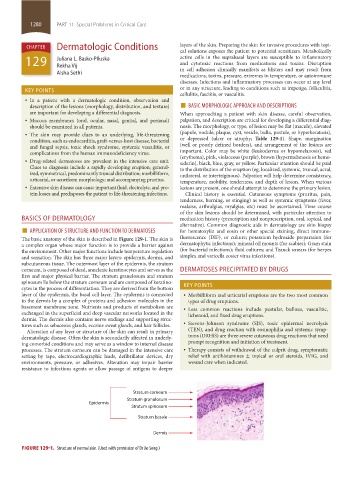
                 The basic anatomy of the skin is described in Figure 129-1. The skin is   fluorescence (DIF), or culture; potassium hydroxide preparation (for
                 a complex organ whose major function is to provide a barrier against   dermatophytic infections); mineral oil mounts (for scabies); Gram stain
                 the environment. Other major functions include temperature regulation   (for bacterial infections); fluid cultures; and Tzanck smears (for herpes
                 and sensation. The skin has three major layers: epidermis, dermis, and   simplex and varicella zoster virus infections).
                 subcutaneous tissue. The outermost layer of the epidermis, the stratum
                 corneum, is composed of dead, anucleate keratinocytes and serves as the  DERMATOSES PRECIPITATED BY DRUGS
                 first and major physical barrier. The stratum granulosum and stratum
                 spinosum lie below the stratum corneum and are composed of keratino-  KEY POINTS
                 cytes in the process of differentiation. They are derived from the bottom
                 layer of the epidermis, the basal cell layer. The epidermis is connected     • Morbilliform and urticarial eruptions are the two most common
                 to the dermis by a complex of proteins and adhesion molecules in the   types of drug eruptions.
                 basement membrane zone. Nutrients and products of metabolism are     • Less common reactions include pustular, bullous, vasculitic,
                 exchanged in the superficial and deep vascular networks located in the   lichenoid, and fixed drug eruptions.
                 dermis. The dermis also contains nerve endings and supporting struc-
                 tures such as sebaceous glands, eccrine sweat glands, and hair follicles.    • Stevens-Johnson syndrome (SJS), toxic epidermal necrolysis
                   Alteration of any layer or structure of the skin can result in primary   (TEN), and drug reaction with eosinophilia and systemic symp-
                 dermatologic disease. Often the skin is secondarily affected in underly-  toms (DRESS) are three severe cutaneous drug reactions that need
                 ing comorbid conditions and may serve as a window to internal disease   prompt recognition and initiation of treatment.
                 processes. The stratum corneum can be damaged in the intensive care     • Therapy consists of withdrawal of the culprit drug, symptomatic
                 setting by tape, electrocardiographic leads, defibrillator devices, dry   relief with antihistamines  ± topical or oral steroids, IVIG, and
                 environments, pressure, or adhesives. Alteration may impair barrier   wound care when indicated.
                 resistance to infectious agents or allow passage of antigens to deeper


                                                       Stratum corneum
                                                     Stratum granulosum
                                        Epidermis
                                                       Stratum spinosum
                                                         Stratum basale

                                                              Dermis

                 FIGURE 129-1.  Structure of normal skin. (Used with permission of Dr Jie Song.)


            section11.indd   1280                                                                                      1/19/2015   10:52:31 AM

