


Page 1813 - Hall et al (2015) Principles of Critical Care-McGraw-Hill
P. 1813
1282     PART 11: Special Problems in Critical Care


                                      1. Patient develops a
                                     possible adverse drug
                                          reaction


                                2. Review of medical history, records,
                               physical exam, and clinical tests support
                                 the occurrence of a drug-induced
                                          reaction


                                                            No         4. Nonimmune adverse event,(eg, toxicity,
                                          3. Drug-                     side effect, drug interaction), idiosyncrasy,
                                       induced hyper-                 intolerance or pseudoallergic effect of the drug
                                         sensitivity/
                                        immunologic
                                          reaction
                                         suspected                         4a. Management:
                                                                           Modify dose (for toxicity, side effect, or drug
                                                                           interactions)
                                                                           Alternative drug
                                             Yes                           Consider slow graded challenges
                                                                           Consider prophylactic regimens before
                                                                           administration (if shown to be effective)
                                                                           Patient education
                                         5. Perform
                                        appropriate                      Not available
                                      confirmatory tests,
                                         if available


                                      Available

                                                                              8. Does test have
                                          6. Tests             No
                                          positive                             high negative
                                                                              predictive value?
                                             Yes
                                                                        Yes                      No

                                                                                           10. Patient may be allergic
                                      7. Diagnosis of drug          9. Patient not
                                                                                          with negative drug-specific
                                  hypersensitivity/immunologic     allergic to the        or nonspecific confirmatory
                                      reaction confirmed              drug
                                                                                                  tests


                                             7a. Management:
                                            Anaphylactic reactions require prompt emergency treatment
                                            Avoid drug if possible
                                            Consider desensitization or graded challenge before administration
                                            Consider prophylactic regimen before administration (if shown to be effective)
                                            Future prudent use of drugs
                                            Future use of drug could cause nonanaphylactic, life-threatening reaction (eg, Stevens-Johnson,
                                            Churg-Strauss), thus absolutely contraindicated
                                            Patient education

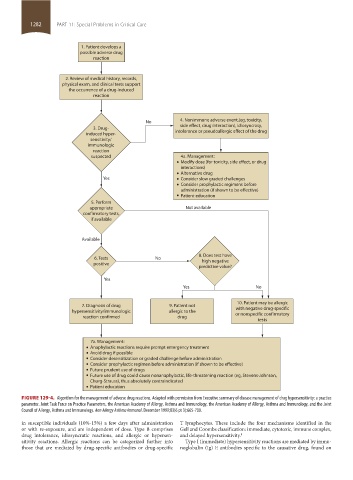
                 FIGURE 129-4.  Algorithm for the management of adverse drug reactions. Adapted with permission from Executive summary of disease management of drug hypersensitivity: a practice
                 parameter. Joint Task Force on Practice Parameters, the American Academy of Allergy, Asthma and Immunology, the American Academy of Allergy, Asthma and Immunology, and the Joint
                 Council of Allergy, Asthma and Immunology. Ann Allergy Asthma Immunol. December 1999;83(6 pt 3):665-700.

                 in susceptible individuals (10%-15%) a few days after administration   T  lymphocytes.  These  include  the four  mechanisms  identified in  the
                 or with re-exposure, and are independent of dose. Type B comprises   Gell and Coombs classification: immediate, cytotoxic, immune complex,
                 drug intolerance, idiosyncratic reactions, and allergic or hypersen-  and delayed hypersensitivity. 8
                 sitivity reactions. Allergic reactions can be categorized further into   Type I (immediate) hypersensitivity reactions are mediated by immu-
                 those that are mediated by drug-specific antibodies or drug-specific     noglobulin (Ig) E antibodies specific to the causative drug, found on


            section11.indd   1282                                                                                      1/19/2015   10:52:40 AM

