


Page 1814 - Hall et al (2015) Principles of Critical Care-McGraw-Hill
P. 1814
CHAPTER 129: Dermatologic Conditions  1283


                                                                          cardiac arrhythmias, urticaria, and pruritus. Drug-induced anaphylaxis
                      TABLE 129-2     Drug Eruption Checklist: Information to Be Elicited From the
                                Patient’s Medical Records or Family       occurs in 1 of 2700 hospitalized patients and is most frequently induced
                                                                          by  β-lactam antibiotics (including penicillin), radiocontrast medium,
                    (1)  Time of onset and course of the reaction         intravenous anesthetic drugs, aspirin, other NSAIDs, and opiates. In
                    (2)  Dosage and time of initiation or discontinuation of any medications, including over-  the United States, the most common cause of anaphylaxis is penicillin.
                                                                                                                             9
                       the-counter and alternative products               Treatment of urticaria consists of discontinuation of the offending drug
                    (3)  The patient’s previous exposure to this or other related medications  and administration of oral antihistamine H  blockers. These include
                                                                                                          1
                    (4)  Any previous history of adverse drug reaction (ADR), its management, and any   diphenhydramine, hydroxyzine, and the nonsedating agents, loratadine,
                         measures taken to prevent future ADRs            cetirizine, and fexofenadine. If anaphylaxis develops, emergency treatment
                    (5)  The patient’s medical problems                   is instituted with intramuscular or subcutaneous epinephrine, high-flow
                    (6)  Any physical or laboratory abnormalities present with the ADR, with special attention   oxygen  and  airway  management,  intravenous  diphenhydramine,  ste-
                       to organ systems involved                          roids, fluids, vasopressors, and cardiopulmonary resuscitation, as needed
                                                                          (Chap. 128). Skin testing with the offending agent is usually positive in
                                                                          IgE-mediated reactions.
                      TABLE 129-3    Indicators that an Adverse Drug Reaction May Become Serious  Cytotoxic (type II) reactions are mediated by IgG and complement,
                    Cutaneous Findings              Systemic Findings     usually occur longer than 72 hours after drug exposure, and manifest as
                                                                          increased clearance of red blood cells and platelets by the lymphoreticu-
                    Confluent erythema              High fever (>40°C)    lar system. More rarely, they may manifest as intravascular destruction
                    Rash or edema involving the face  Lymphadenopathy     by complement-mediated lysis. Skin testing is not useful.
                    Tender skin lesions             Joint pain             Type III reactions are serum sickness-like reactions, in which IgG or
                                                                          IgM immune complex deposition leads to diffuse tissue injury. Common
                    Palpable purpura                Dyspnea, wheezing, hypotension  clinical findings include fever, urticaria, angioedema, malaise, arthral-
                    Necrotizing skin lesions                              gias (particularly of the hands and feet with swelling), lymphadenopa-
                    Vesicles/bullae                 Laboratory Findings   thy, and occasionally nephritis or endocarditis, usually starting after 1
                                                                          to 3 weeks of drug administration. There is an associated eosinophilia.
                    Positive Nikolsky sign a        Abnormal liver function tests
                                                                          Heterologous antisera, xenogeneic antibodies, and drugs such as peni-
                    Mucous membrane erosions        Lymphocytosis with atypia  cillins, minocycline, bupropion, and propranolol are the most com-
                    Urticaria                       Eosinophilia (>1000/mm ) 3  mon triggers. Cefaclor, a second-generation cephalosporin, has also
                                                                          been reported to cause serum sickness-like reactions in adults, albeit
                    Tongue edema
                                                                          less frequently than in children.  Systemic steroids are often used
                                                                                                  10
                    a Outer layer of epidermis separates readily with lateral pressure.  to treat this reaction, although large-scale controlled clinical trials
                    Roujeau and Stern. 44                                 are lacking.
                                                                           Type IV, delayed-type hypersensitivity reactions occur as a result of an
                    mast cells and peripheral blood basophils, and occur more frequently   immune reaction to a hapten-carrier complex. Under physiological con-
                    with parenteral administration. They usually occur within 1 hour of   ditions, drugs can bind covalently to a larger protein or peptide, forming
                    drug administration, but may occur as late as 72 hours in the absence   stable hapten-carrier complexes which are then processed and presented
                    of prior sensitization to the drug. Type I hypersensitivity reactions often   on MHC molecules as immunogenic peptides. This leads to primary
                    manifest as urticaria, angioedema, or anaphylaxis. Urticarial lesions are   sensitization to the drug. After primary sensitization has occurred, an
                    pruritic, erythematous or white, nonpitting, round or oval edematous   allergic reaction can be elicited by topical or systemic administration
                    papules or plaques surrounded by a clear or red halo, usually at different   of the same or a structurally similar agent. Occasionally, a reaction may
                    stages of formation (Fig. 129-3). Angioedema refers to the same patho-  appear de novo after several days of contact with the offending agent.
                    physiologic process as urticaria with transudation of interstitial fluid   Allergic contact dermatitis (Fig. 129-5) is the most common type IV,
                    into the dermis or hypodermis. Anaphylaxis is a severe allergic reaction   delayed-type hypersensitivity reaction, usually caused by topically
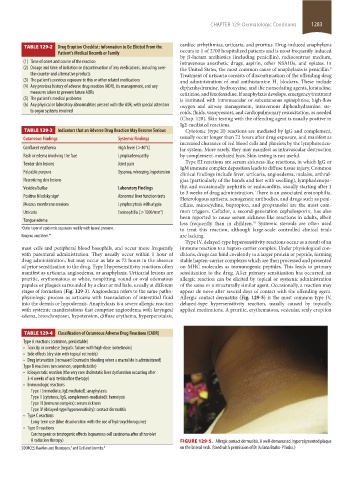
                    with systemic manifestations that comprise angioedema with laryngeal   applied medications. A pruritic, erythematous, vesicular, scaly eruption
                    edema, bronchospasm, hypotension, diffuse erythema, hyperperistalsis,


                      TABLE 129-4    Classification of Cutaneous Adverse Drug Reactions (CADR)
                    Type A reactions (common, predictable)
                    •  Toxicity or overdose (hepatic failure with high-dose isotretinoin)
                    •  Side effects (dry skin with topical retinoids)
                    •  Drug interaction (increased Coumadin bleeding when a macrolide is administered)
                    Type B reactions (uncommon, unpredictable)
                    •  Idiosyncratic reaction (the very rare cholestatic liver dysfunction occurring after
                      3-4 weeks of oral terbinafine therapy)
                    •  Immunologic reactions
                       Type I (immediate, IgE mediated): anaphylaxis
                       Type II (cytotoxic, IgG, complement-mediated): hemolysis
                       Type III (immune complex): serum sickness
                       Type IV (delayed-type hypersensitivity): contact dermatitis
                    •  Type C reactions
                       Long-term use (blue discoloration with the use of hydroxychloroquine)
                    •  Type D reactions
                       Carcinogenic or teratogenic effects (squamous cell carcinoma after ultraviolet
                       A  radiation therapy)                              FIGURE 129-5.  Allergic contact dermatitis. A well-demarcated, hyperpigmented plaque
                    SOURCES: Rawlins and Thompson,  and Gell and Coombs. 8  on the lateral neck. (Used with permission of Dr Juliana Basko-Plluska.)
                                    5


            section11.indd   1283                                                                                      1/19/2015   10:52:42 AM

