


Page 1815 - Hall et al (2015) Principles of Critical Care-McGraw-Hill
P. 1815
1284     PART 11: Special Problems in Critical Care


                 occurs at the site of contact, which, with time, may become lichenified     TABLE 129-5    Chemotherapy-Induced Dermatoses
                 (thickened with accentuation of skin markings) related to rubbing or
                 scratching.                                            Type of Reaction  Responsible Drugs  Treatment
                   Diagnostic tests for CADR may be useful to determine the causative   Alopecia (anagen or    Vincristine, cyclophosphamide,  •  None
                 agent, the type of reaction, and the prognosis. Skin testing may be   telogen effluvium)  doxorubicin, daunorubicin,
                 performed by a prick or intradermal administration of the suspected   dactinomycin, paclitaxel
                 drugs to determine the presence of drug-specific IgE antibodies (type I
                 Gell-Coombs reactions). Penicillin, muscle relaxants, and barbiturates   Mucositis/stomatitis  Topotecan, methotrexate,    •  Oral hygiene
                 are amenable to this type of testing because their epitopes are known.   fluorouracil, doxorubicin,    •  Magnesium/aluminum
                 Medicines that undergo significant metabolism and those with unde-    dactinomycin, bleomycin,    hydroxide
                 fined epitopes cannot be tested. An in vitro test to study the presence   docetaxel, daunorubicin  •  Viscous lidocaine
                 of circulating drug-specific  IgE antibodies is the radioallergosorbent                  •  Benzocaine
                 test. Penicillin, insulin, thiopental, protamine, latex, chymopapain, and                •  Diphenhydramine elixir
                 selected muscle relaxants can be tested by radioallergosorbent test, with   Candidiasis  Vincristine, cisplatin,   •  Nystatin wash/cream
                 variable consistency.                                                   doxorubicin, daunorubicin
                   When ADRs are mediated by drug-specific T cells (type IV; eg, contact   Extravasation reactions  Bleomycin, carboplatin,    •  Discontinue infusion
                 dermatitis), patch testing is a useful adjunct. It is performed by applying   cyclophosphamide,  doxorubicin,  •  Elevate effected extremity
                 predetermined dilutions of the compound on intact skin for different   etoposide, paclitaxel,   •  Apply local heat or cold
                 periods and assessing for erythema, edema, or vesiculation, all indicative     vinblastine  •  Debridement/skin grafting
                 of specific T-cell reactivity. A skin biopsy aids in clarifying the patho-               •  Use antidotes
                 physiology of a reaction, for example, by the demonstration of immune       a     b
                 complexes, leukocytoclastic vasculitis, or tissue eosinophilia. Blood   Hyperpigmentation    Bleomycin,  cisplatin,    •  None
                                                                        (localized or diffuse)
                                                                                       methotrexate,  cyclophospha-
                                                                                               c
                 eosinophil counts have been regarded as an indicator of ADR; however,
                 recent studies have shown that this criterion carries a low sensitiv-  mide, daunorubicin, doxorubicin
                                                                                       fluorouracil, hydroxyurea,
                 ity (22%-36%, depending on arbitrarily defined cutoff rates), making
                 routine  eosinophil  testing  unhelpful.   Serum  tryptase  levels  are    vinblastine, 5-fluorouracil
                                              11
                 useful in reactions caused by diffuse mast cell (anaphylactic or anaphy-  Acral erythema  Cytarabine, doxorubicin,    •  Elevate the extremity
                 lactoid) activation, especially when hemodynamic changes are present.   fluorouracil     •  Cold compresses
                 Tryptase is a protease stored in the granules of mast cells and released                 •  Analgesics
                 with mast cell activation. Levels should be obtained within 2 hours of                   •  Pyridoxine 150 mg daily
                 the  anaphylactic  episode.  Serum  tryptase  concentrations  are  recom-  Lower extremity   Hydroxyurea, methotrexate  •  Discontinue the drug
                 mended over serum histamine concentrations due to the greater stability     ulcerations
                 of tryptase. 12                                        Neutrophilic eccrine    Cytarabine, bleomycin,    •  None
                   The clinical usefulness of in vitro diagnostic tests to detect the pres-  hidradenitis  cyclophosphamide, cisplatin,
                 ence of drug-specific antibodies capable of eliciting basophil histamine   topotecan, anthracyclines
                 release, lymphocyte blast transformation, or complement activation
                 remains to be proven. These tests carry a low sensitivity, are currently   a Causes flagellate streaks of hyperpigmentation.
                 used mainly as research tools, and therefore are not recommended for   b Gingival bands.
                 routine clinical use.                                 c Flag sign = horizontal hyperpigmented bands on blond hair.
                   Despite the different proposed mechanisms, overlap is common, and
                 one cannot infer the pathogenesis of an eruption by its morphology or   such as attapulgite, magnesium/aluminum hydroxide, diphenhydramine
                 causative drug alone. The diagnosis of a drug-related dermatosis encom-  elixir, benzocaine, and viscous lidocaine.
                 passes a complex mental algorithm of probability, time and causality,   Candidiasis, with its white, adherent velvety plaques, and varicella
                 alternative diagnoses, and plausibility.              zoster virus may also affect the inside of the mouth. Herpes simplex
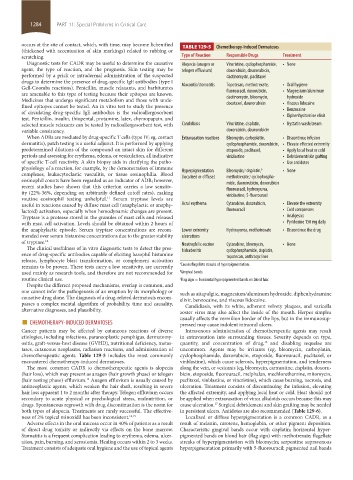
                     ■  CHEMOTHERAPY-INDUCED DERMATOSES                usually affects the vermilion border of the lips, but in the immunosup-
                                                                       pressed may cause indolent intraoral ulcers.
                 Cancer  patients may be  affected by cutaneous reactions of  diverse   Intravenous administration of chemotherapeutic agents may result
                 etiologies, including infections, paraneoplastic pemphigus, dermatomy-  in  extravasation  into  surrounding  tissues.  Severity  depends  on  type,
                 ositis, graft-versus-host disease (GVHD), nutritional deficiency, metas-  quantity, and concentration of drug,  and disabling sequelae are
                                                                                                    16
                 tases, cutaneous neoplasms, radiation reactions, and administration of   uncommon. Agents may be irritants (eg, bleomycin, carboplatin,
                 chemotherapeutic agents.  Table 129-5 includes the most commonly   cyclophosphamide, doxorubicin, etoposide, fluorouracil, paclitaxel, or
                 encountered chemotherapy-induced dermatoses.          vinblastine), which cause sclerosis, hyperpigmentation, and tenderness
                   The most common CADR to chemotherapeutic agents is alopecia   along the vein, or vesicants (eg, bleomycin, carmustine, cisplatin, doxoru-
                 (hair loss), which may present as anagen (hair growth phase) or telogen   bicin, etoposide, fluorouracil, melphalan, mechlorethamine, mitomycin,
                 (hair resting phase) effluvium.  Anagen effluvium is usually caused by   paclitaxel, vinblastine, or vincristine), which cause burning, necrosis, and
                                       13
                 antineoplastic agents, which weaken the hair shaft, resulting in severe   ulceration. Treatment consists of discontinuing the infusion, elevating
                 hair loss apparent 1 to 2 months after therapy. Telogen effluvium occurs   the affected extremity, and applying local heat or cold. Heat should not
                 secondary to acute physical or psychological stress, malnutrition, or   be applied when extravasation of vinca alkaloids occurs because this may
                 drugs. Spontaneous regrowth with drug discontinuation is the norm for   cause ulceration.  Surgical debridement and skin grafting may be needed
                                                                                   17
                 both types of alopecia. Treatments are rarely successful. The effective-  in persistent ulcers. Antidotes are also recommended (Table 129-6).
                 ness of 2% topical minoxidil has been inconsistent. 14,15  Localized or diffuse hyperpigmentation is a common CADR, as a
                   Adverse effects in the oral mucosa occur in 40% of patients as a result   result of melanin, carotene, hemoglobin, or other pigment deposition.
                 of direct drug toxicity or indirectly via effects on the bone marrow.    Characteristic gingival bands occur with  cisplatin; horizontal hyper-
                 Stomatitis is a frequent complication leading to erythema, edema, ulcer-  pigmented bands on blond hair (flag sign) with methotrexate; flagellate
                 ation, pain, burning, and xerostomia. Healing occurs within 2 to 3 weeks.   streaks of hyperpigmentation with bleomycin; serpentine supravenous
                 Treatment consists of adequate oral hygiene and the use of topical agents   hyperpigmentation primarily with 5-fluorouracil; pigmented nail bands


            section11.indd   1284                                                                                      1/19/2015   10:52:42 AM

