


Page 1816 - Hall et al (2015) Principles of Critical Care-McGraw-Hill
P. 1816
CHAPTER 129: Dermatologic Conditions  1285


                                                                          and topotecan have also been implicated. NEH typically resolves within
                      TABLE 129-6    Antidotes Used in Chemotherapeutic Agent Extravasation
                                                                          weeks after cessation of chemotherapy, although it may recur in subse-
                    Agent                     Antidote                    quent cycles. Dapsone is used to treat and prevent recurrences of NEH. 22
                    Anthracycline             Topical DMSO                    ■
                    Mitomycin                 Topical DMSO                  ANTICOAGULANT-INDUCED DERMATOSES
                                                                          Adverse reactions to anticoagulants can be localized or diffuse and
                    Vinca alkaloid            Hyaluronidase (ICA)
                                                                          mediated by various mechanisms. Unfractionated heparin, low-molecu-
                    Mechlorethamine           Sodium thiosulfate (ICA)    lar-weight heparins, and vitamin K antagonists are drugs used routinely
                    Dacarbazine               Sodium thiosulfate (ICA)    in the treatment and prophylaxis of thromboembolic disease. In addi-
                    Cisplatin                 Sodium thiosulfate (ICA)    tion to the well-known ADRs such as an increased bleeding tendency,
                                                                          these agents may cause CADR which necessitate institution of alterna-
                    DMSO, dimethylsulfoxide; ICA, intracutaneous administration.
                                                                          tive therapies.
                    Data from Susser WS, Whitaker-Worth DL, Grant-Kels JM. Mucocutaneous reactions to chemotherapy.    Heparin is a mucopolysaccharide that can induce various ADRs,
                    J Am Acad Dermatol. March 1999;40(3):367-398.         including immediate reactions (eg, urticaria, asthma, and anaphylaxis),
                                                                          and delayed-type reactions (eg, erythematous plaques, skin necrosis, a
                                                                                                           23
                    with bleomycin, cytarabine, cyclophosphamide, daunorubicin, doxo-  generalized eruption, and thrombocytopenia).  Delayed-type reactions
                    rubicin, fluorouracil, hydroxyurea, idarubicin, mitomycin, tegafur, or     manifest as erythematous, vesicular, or pruritic plaques at the injection
                    vinblastine; and mucosal hyperpigmentation with busulfan, fluorouracil,    site within 2 to 5 days of therapy, whereas heparin-induced skin necrosis
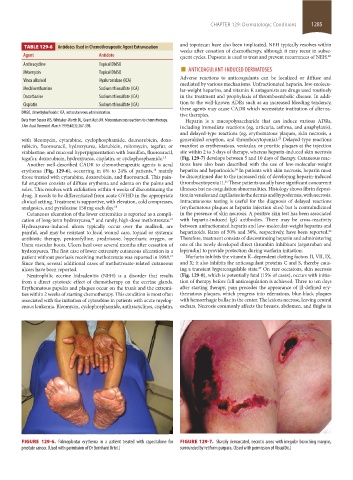
                    tegafur, doxorubicin, hydroxyurea, cisplatin, or cyclophosphamide. 13  (Fig. 129-7) develops between 5 and 10 days of therapy. Cutaneous reac-
                     Another well-described CADR to chemotherapeutic agents is acral   tions have also been described with the use of low-molecular-weight
                                                                                            24
                    erythema (Fig. 129-6), occurring in 6% to 24% of patients,  mainly   heparins and heparinoids.  In patients with skin necrosis, heparin must
                                                                18
                    those treated with cytarabine, doxorubicin, and fluorouracil. This pain-  be discontinued due to the increased risk of developing heparin-induced
                                                                                         25
                    ful eruption consists of diffuse erythema and edema on the palms and   thrombocytopenia II.  These patients usually have significant concurrent
                    soles. This resolves with exfoliation within 4 weeks of discontinuing the   illnesses but no coagulation abnormalities. Histology shows fibrin deposi-
                    drug. It needs to be differentiated from acute GVHD in the appropriate     tion in venules and capillaries in the dermis and hypodermis, with necrosis.
                    clinical setting. Treatment is supportive, with elevation, cold compresses,   Intracutaneous  testing  is useful  for the  diagnosis of  delayed reactions
                    analgesics, and pyridoxine 150 mg each day. 19        (erythematous plaques at heparin injection sites) but is contraindicated
                     Cutaneous ulceration of the lower extremities is reported as a compli-  in the presence of skin necrosis. A positive skin test has been associated
                    cation of long-term hydroxyurea,  and rarely, high-dose methotrexate.    with heparin-induced IgG antibodies. There may be cross-reactivity
                                           20
                                                                      21
                    Hydroxyurea-induced ulcers typically occur over the malleoli, are   between unfractionated heparin and low-molecular-weight heparins and
                    painful, and may be resistant to local wound care, topical or systemic   heparinoids. Rates of 50% and 30%, respectively, have been reported.
                                                                                                                            26
                    antibiotic therapy, pentoxifylline, prednisone, hyperbaric oxygen, or   Therefore, treatment consists of discontinuing heparin and administering
                    Unna vascular boots. Ulcers heal over several months after cessation of   one of the newly developed direct thrombin inhibitors (argatroban and
                    hydroxyurea. The first case of lower extremity cutaneous ulceration in a   lepirudin) to provide protection during warfarin initiation.
                    patient without psoriasis receiving methotrexate was reported in 1998.    Warfarin inhibits the vitamin K–dependent clotting factors II, VII, IX,
                                                                      21
                    Since then, several additional cases of methotrexate-related cutaneous   and X; it also inhibits the anticoagulant proteins C and S, thereby caus-
                    ulcers have been reported.                            ing a transient hypercoagulable state.  On rare occasions, skin necrosis
                                                                                                    27
                     Neutrophilic eccrine hidradenitis (NEH) is a disorder that results   (Fig. 129-8), which is potentially fatal (15% of cases), occurs with initia-
                    from a direct cytotoxic effect of chemotherapy on the eccrine glands.   tion of therapy before full anticoagulation is achieved. Three to ten days
                    Erythematous papules and plaques occur on the trunk and the extremi-  after starting therapy, pain precedes the appearance of ill-defined ery-
                    ties within 2 weeks of starting chemotherapy. This condition is most often   thematous plaques, which progress into edematous, blue-black plaques
                    associated with the initiation of cytarabine in patients with acute myelog-  with hemorrhagic bullae in the center. The lesions necrose, leaving central
                    enous leukemia. Bleomycin, cyclophosphamide, anthracyclines, cisplatin,   eschars. Necrosis commonly affects the breasts, abdomen, and thighs in


                    FIGURE 129-6.  Palmoplantar erythema in a patient treated with capecitabine for   FIGURE 129-7.  Sharply demarcated, necrotic areas with irregular branching margins,
                      prostate cancer. (Used with permission of Dr Bernhard Ortel.)  surrounded by retiform purpura. (Used with permission of VisualDx.)


            section11.indd   1285                                                                                      1/19/2015   10:52:51 AM

