


Page 1817 - Hall et al (2015) Principles of Critical Care-McGraw-Hill
P. 1817
1286     PART 11: Special Problems in Critical Care


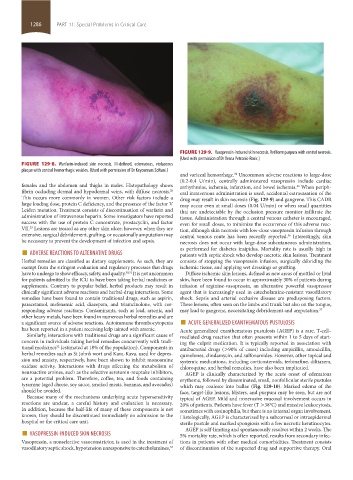
                                                                       FIGURE 129-9.  Vasopressin-induced skin necrosis. Retiform purpura with central necrosis.
                                                                       (Used with permission of Dr Vesna Petronic-Rosic.)
                 FIGURE 129-8.  Warfarin-induced skin necrosis. Ill-defined, edematous, violaceous
                 plaque with central hemorrhagic vesicles. (Used with permission of Dr Keyoumars Soltani.)
                                                                       and variceal hemorrhage.  Uncommon adverse reactions to large-dose
                                                                                          34
                                                                       (0.2-0.4 U/min), centrally administered vasopressin include cardiac
                 females and the abdomen and thighs in males. Histopathology shows   arrhythmias, ischemia, infarction, and bowel ischemia.  When periph-
                                                                                                               46
                 fibrin occluding dermal and hypodermal veins, with diffuse necrosis.    eral intravenous administration is used, accidental extravasation of the
                                                                    28
                 This occurs more commonly in women. Other risk factors include a   drug may result in skin necrosis (Fig. 129-9) and gangrene. This CADR
                 large loading dose, protein C deficiency, and the presence of the factor V   may occur even at small doses (0.04 U/min) or when small quantities
                 Leiden mutation. Treatment consists of discontinuation of warfarin and   that are undetectable by the occlusion pressure monitor infiltrate the
                 administration of intravenous heparin. Some investigators have reported   tissue. Administration through a central venous catheter is encouraged,
                 success with the use of protein C concentrate, prostacyclin, and factor   even for small doses, to minimize the occurrence of this adverse reac-
                 VII.  Lesions are treated as any other skin ulcer; however, when they are   tion, although skin necrosis with low-dose vasopressin infusion through
                    29
                 extensive, surgical debridement, grafting, or occasionally amputation may   central venous route has been recently reported.  Interestingly, skin
                                                                                                            36
                 be necessary to prevent the development of infection and sepsis.  necrosis does not occur with large-dose subcutaneous administration,
                     ■  ADVERSE REACTIONS TO ALTERNATIVE DRUGS         as performed for diabetes insipidus. Mortality rate is usually high in
                                                                       patients with septic shock who develop necrotic skin lesions. Treatment
                 Herbal remedies are classified as dietary supplements. As such, they are   consists of stopping the vasopressin infusion, surgically débriding the
                 exempt from the stringent evaluation and regulatory processes that drugs   ischemic tissue, and applying wet dressings or grafting.
                 have to undergo to show efficacy, safety, and quality. 30,31  It is not uncommon     Diffuse ischemic skin lesions, defined as new areas of mottled or livid
                 for patients admitted to the ICU to have been taking herbal medicines or   skin, have been found to occur in approximately 30% of patients during
                 supplements. Contrary to popular belief, herbal products may result in   infusion of arginine-vasopressin, an alternative powerful vasopressor
                 clinically significant adverse reactions and herbal-drug interactions. Some   agent that is increasingly used in catecholamine-resistant vasodilatory
                 remedies have been found to contain traditional drugs, such as aspirin,   shock. Sepsis and arterial occlusive disease are predisposing factors.
                 paracetamol, mefenamic acid, diazepam, and triamcinolone, with cor-  These lesions, often seen on the limbs and trunk but also on the tongue,
                 responding adverse reactions. Contaminants, such as lead, arsenic, and   may lead to gangrene, necessitating debridement and amputation. 37
                 other heavy metals, have been found in numerous herbal remedies and are
                 a significant source of adverse reactions. Autoimmune thrombocytopenia     ■  ACUTE GENERALIZED EXANTHEMATOUS PUSTULOSIS
                 has been reported in a patient receiving kelp tainted with arsenic.  Acute generalized exanthematous pustulosis (AGEP) is a rare, T-cell–
                   Similarly, interactions with traditional drugs are a significant cause of   mediated drug reaction that often presents within 1 to 5 days of start-
                 concern in individuals taking herbal remedies concurrently with tradi-  ing the culprit medication. It is typically reported in association with
                 tional medicines  (estimated at 18% of the population). Components in   antibacterial drugs (>90% of cases) including ampicillin, amoxicillin,
                             32
                 herbal remedies such as St John’s wort and Kava-Kava, used for depres-  quinolones, clindamycin, and sulfonamides. However, other topical and
                 sion and anxiety, respectively, have been shown to inhibit monoamine   systemic medications, including corticosteroids, terbinafine, diltiazem,
                 oxidase activity. Interactions with drugs affecting the metabolism of   chloroquine, and herbal remedies, have also been implicated.
                 neuroactive amines, such as the selective serotonin-reuptake inhibitors,   AGEP is clinically characterized by the acute onset of edematous
                 are  a  potential  problem.  Therefore,  coffee,  tea,  and  foods  containing   erythema, followed by disseminated, small, nonfollicular sterile pustules
                 tyramine (aged cheese, soy sauce, smoked meats, bananas, and avocados)    which may coalesce into bullae (Fig. 129-10). Marked edema of the
                 should be avoided.                                    face, target-like lesions, blisters, and purpura may be seen, but are not
                   Because many of the mechanisms underlying acute hypersensitivity    typical of AGEP. Mild and nonerosive mucosal involvement occurs in
                 reactions  are  unclear,  a  careful  history  and  evaluation  is  necessary.   20% of patients. Patients have fever (T >38°C) and massive leukocytosis,
                 In addition, because the half-life of many of these components is not   sometimes with eosinophilia, but there is no internal organ involvement.
                 known, they should be discontinued immediately on admission to the   Histologically, AGEP is characterized by a subcorneal or intraepidermal
                 hospital or the critical care unit.                   sterile pustule and marked spongiosis with a few necrotic keratinocytes.
                     ■  VASOPRESSIN-INDUCED SKIN NECROSIS              5% mortality rate, which is often reported, results from secondary infec-
                                                                         AGEP is self-limiting and spontaneously resolves within 2 weeks. The
                 Vasopressin, a nonselective vasoconstrictor, is used in the treatment of   tions in patients with other medical comorbidities. Treatment consists
                 vasodilatory septic shock, hypotension unresponsive to catecholamines,    of discontinuation of the suspected drug and supportive therapy. Oral
                                                                    33


            section11.indd   1286                                                                                      1/19/2015   10:53:02 AM

