


Page 50 - Review of Medical Microbiology and Immunology ( PDFDrive )
P. 50
mebooksfree.com
mebooksfree.com
mebooksfree.com
mebooksfree.com
mebooksfree.com
mebooksfree.com
mebooksfree.com
mebooksfree.com mebooksfree.com mebooksfree.com For example, the fatal dose of tetanus toxin for a human is 39 mebooksfree.com
mebooksfree.com
CHAPTER 7 Pathogenesis
Exotoxins are among the most toxic substances known.
because receptors for these microbes are located on the
surface of brain neurons. The blood–brain barrier, which
limits the ability of certain drugs to penetrate the brain, is
estimated to be less than 1 μg. Because some purified exo-
not thought to be a determinant of microbial infection of
toxins can reproduce all aspects of the disease, we can
conclude that certain bacteria play no other role in patho-
the brain. The concept of a blood–brain barrier primarily
refers to the inability of hydrophilic (charged, ionized)
drugs to enter the lipid-rich brain parenchyma, whereas
tides are good antigens and induce the synthesis of
protective antibodies called antitoxins, some of which are
lipophilic (lipid-soluble) drugs enter well.
Two important diseases, diphtheria and pseudomem- genesis than to synthesize the exotoxin. Exotoxin polypep-
useful in the prevention or treatment of diseases such as
branous colitis, are characterized by inflammatory lesions
mebooksfree.com mebooksfree.com mebooksfree.com retain their antigenicity but have lost their toxicity. mebooksfree.com
mebooksfree.com
mebooksfree.com
botulism and tetanus. When treated with formaldehyde (or
called pseudomembranes. Pseudomembranes are thick,
acid or heat), the exotoxin polypeptides are converted into
toxoids, which are used in protective vaccines because they
adherent, grayish or yellowish exudates on the mucosal
surfaces of the throat in diphtheria and on the colon in
Many exotoxins have an A–B subunit structure; the A
pseudomembranous colitis. The term pseudo refers to the
(or active) subunit possesses the toxic activity, and the B (or
abnormal nature of these membranes in contrast to the
binding) subunit is responsible for binding the exotoxin to
normal anatomic membranes of the body, such as the tym-
specific receptors on the membrane of the human cell. The
panic membrane and the placental membranes.
binding of the B subunit determines the specific site of the
action of the exotoxin. For example, botulinum toxin acts
4. Toxin Production
at the neuromuscular junction because the B subunit binds
The second major mechanism by which bacteria cause dis-
to specific receptors on the surface of the motor neuron at
ease is the production of toxins. A comparison of the main
the junction. Important exotoxins that have an A–B subunit
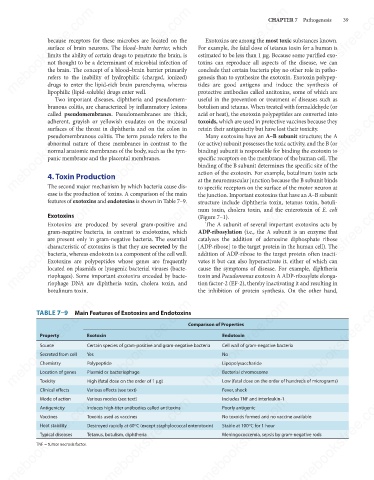
features of exotoxins and endotoxins is shown in Table 7–9.
mebooksfree.com
mebooksfree.com mebooksfree.com mebooksfree.com structure include diphtheria toxin, tetanus toxin, botuli- mebooksfree.com
mebooksfree.com
num toxin, cholera toxin, and the enterotoxin of E. coli
Exotoxins
(Figure 7–1).
Exotoxins are produced by several gram-positive and
The A subunit of several important exotoxins acts by
ADP-ribosylation (i.e., the A subunit is an enzyme that
gram-negative bacteria, in contrast to endotoxins, which
catalyzes the addition of adenosine diphosphate ribose
are present only in gram-negative bacteria. The essential
[ADP-ribose] to the target protein in the human cell). The
characteristic of exotoxins is that they are secreted by the
bacteria, whereas endotoxin is a component of the cell wall.
addition of ADP-ribose to the target protein often inacti-
vates it but can also hyperactivate it, either of which can
Exotoxins are polypeptides whose genes are frequently
cause the symptoms of disease. For example, diphtheria
located on plasmids or lysogenic bacterial viruses (bacte-
riophages). Some important exotoxins encoded by bacte-
toxin and Pseudomonas exotoxin A ADP-ribosylate elonga-
riophage DNA are diphtheria toxin, cholera toxin, and
tion factor-2 (EF-2), thereby inactivating it and resulting in
botulinum toxin.
the inhibition of protein synthesis. On the other hand,
mebooksfree.com
mebooksfree.com mebooksfree.com Exotoxin mebooksfree.com Comparison of Properties mebooksfree.com mebooksfree.com
TABLE 7–9 Main Features of Exotoxins and Endotoxins
Endotoxin
Property
Source
Cell wall of gram-negative bacteria
Certain species of gram-positive and gram-negative bacteria
Yes
No
Secreted from cell
Lipopolysaccharide
Polypeptide
Chemistry
Location of genes
Low (fatal dose on the order of hundreds of micrograms)
Toxicity
High (fatal dose on the order of 1 μg)
Fever, shock
Clinical effects Plasmid or bacteriophage Bacterial chromosome
Various effects (see text)
mebooksfree.com
mebooksfree.com mebooksfree.com Toxoids used as vaccines mebooksfree.com mebooksfree.com mebooksfree.com
Includes TNF and interleukin-1
Mode of action
Various modes (see text)
Antigenicity
Poorly antigenic
Induces high-titer antibodies called antitoxins
No toxoids formed and no vaccine available
Vaccines
Destroyed rapidly at 60°C (except staphylococcal enterotoxin)
Heat stability
Stable at 100°C for 1 hour
Tetanus, botulism, diphtheria
Typical diseases
Meningococcemia, sepsis by gram-negative rods
TNF = tumor necrosis factor.
mebooksfree.com mebooksfree.com mebooksfree.com mebooksfree.com mebooksfree.com mebooksfree.com

