


Page 124 - Textbook of Pathology, 6th Edition
P. 124
108                                                      from varicose veins due to high pressure in the veins of legs
                                                               or oesophagus.
                                                               EFFECTS.  The effects of blood loss depend upon 3 main
                                                               factors:
                                                                   the amount of blood loss;
                                                                   the speed of blood loss; and
                                                                   the site of haemorrhage.
                                                                  The loss up to 20% of blood volume suddenly or slowly
                                                               generally has little clinical effects because of compensatory
     SECTION I
                                                               mechanisms. A sudden loss of 33% of blood volume may
                                                               cause death, while loss of up to 50% of blood volume over a
                                                               period of 24 hours may not be necessarily fatal. However,
                                                               chronic blood loss generally produces iron deficiency
                                                               anaemia, whereas acute haemorrhage may lead to serious
                                                               immediate consequences such as hypovolaemic shock.

                                                               SHOCK
                                                               Definition
                                                               Shock is a life-threatening clinical syndrome of cardio-
                                                               vascular collapse characterised by:
                                                                   an acute reduction of effective circulating blood volume
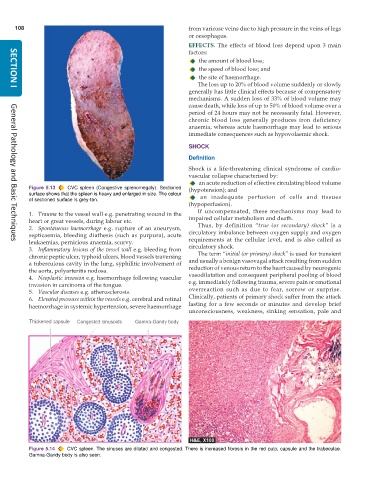
           Figure 5.13  CVC spleen (Congestive splenomegaly). Sectioned  (hypotension); and
           surface shows that the spleen is heavy and enlarged in size. The colour  an inadequate perfusion of cells and tissues
           of sectioned surface is grey-tan.
                                                               (hypoperfusion).
           1. Trauma to the vessel wall e.g. penetrating wound in the  If uncompensated, these mechanisms may lead to
           heart or great vessels, during labour etc.          impaired cellular metabolism and death.
           2. Spontaneous haemorrhage e.g. rupture of an aneurysm,  Thus, by definition “true (or secondary) shock” is a
           septicaemia, bleeding diathesis (such as purpura), acute  circulatory imbalance between oxygen supply and oxygen
           leukaemias, pernicious anaemia, scurvy.             requirements at the cellular level, and is also called as
     General Pathology and Basic Techniques
           3. Inflammatory lesions of the vessel wall e.g. bleeding from  circulatory shock.
           chronic peptic ulcer, typhoid ulcers, blood vessels traversing  The term “initial (or primary) shock” is used for transient
           a tuberculous cavity in the lung, syphilitic involvement of  and usually a benign vasovagal attack resulting from sudden
           the aorta, polyarteritis nodosa.                    reduction of venous return to the heart caused by neurogenic
           4. Neoplastic invasion e.g. haemorrhage following vascular  vasodilatation and consequent peripheral pooling of blood
           invasion in carcinoma of the tongue.                e.g. immediately following trauma, severe pain or emotional
           5. Vascular diseases e.g. atherosclerosis.          overreaction such as due to fear, sorrow or surprise.
           6. Elevated pressure within the vessels e.g. cerebral and retinal  Clinically, patients of primary shock suffer from the attack
           haemorrhage in systemic hypertension, severe haemorrhage  lasting for a few seconds or minutes and develop brief
                                                               unconsciousness, weakness, sinking sensation, pale and


           Figure 5.14  CVC spleen. The sinuses are dilated and congested. There is increased fibrosis in the red pulp, capsule and the trabeculae.
           Gamna-Gandy body is also seen.

