


Page 127 - Textbook of Pathology, 6th Edition
P. 127
hyperdynamic circulation in septic shock, in contrast to  111
                                                               hypovolaemic and cardiogenic shock. Increased vascular
                                                               permeability causes development of inflammatory oedema.
                                                               Disseminated intravascular coagulation (DIC) is prone to
                                                               develop in septic shock due to endothelial cell injury by
                                                               toxins. Reduced blood flow produces hypotension,
                                                               inadequate perfusion of cells and tissues, finally leading to  CHAPTER 5
                                                               organ dysfunction.

                                                               Pathophysiology (Stages of Shock)
                                                               Although deterioration of the circulation in shock is a
                                                               progressive and continuous phenomenon and compensatory
                                                               mechanisms become progressively less effective, historically
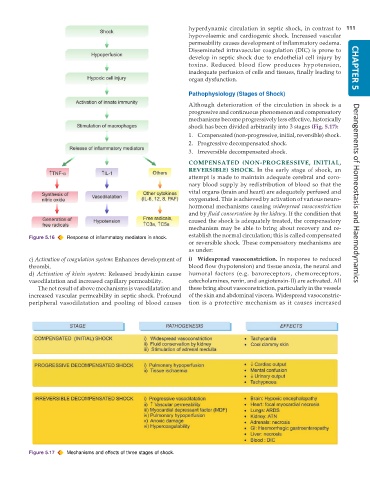
                                                               shock has been divided arbitrarily into 3 stages (Fig. 5.17):
                                                               1. Compensated (non-progressive, initial, reversible) shock.
                                                               2. Progressive decompensated shock.
                                                               3. Irreversible decompensated shock.

                                                               COMPENSATED (NON-PROGRESSIVE, INITIAL,
                                                               REVERSIBLE) SHOCK.  In the early stage of shock, an
                                                               attempt is made to maintain adequate cerebral and coro-
                                                               nary blood supply by redistribution of blood so that the
                                                               vital organs (brain and heart) are adequately perfused and  Derangements of Homeostasis and Haemodynamics
                                                               oxygenated. This is achieved by activation of various neuro-
                                                               hormonal mechanisms causing widespread vasoconstriction
                                                               and by fluid conservation by the kidney. If the condition that
                                                               caused the shock is adequately treated, the compensatory
                                                               mechanism may be able to bring about recovery and re-
                                                               establish the normal circulation; this is called compensated
           Figure 5.16  Response of inflammatory mediators in shock.
                                                               or reversible shock. These compensatory mechanisms are
                                                               as under:
           c) Activation of coagulation system: Enhances development of  i) Widespread vasoconstriction. In response to reduced
           thrombi.                                            blood flow (hypotension) and tissue anoxia, the neural and
           d)  Activation of kinin system:  Released bradykinin cause  humoral factors (e.g. baroreceptors, chemoreceptors,
           vasodilatation and increased capillary permeability.  catecholamines, renin, and angiotensin-II) are activated. All
              The net result of above mechanisms is vasodilatation and  these bring about vasoconstriction, particularly in the vessels
           increased vascular permeability in septic shock. Profound  of the skin and abdominal viscera. Widespread vasoconstric-
           peripheral vasodilatation and pooling of blood causes  tion is a protective mechanism as it causes increased


           Figure 5.17  Mechanisms and effects of three stages of shock.

