


Page 316 - Textbook of Pathology, 6th Edition
P. 316
300   deficient reticuloendothelial iron stores and absence of  of iron stores is desired such as in women with severe
            siderotic iron granules from developing normoblasts.  anaemia a few weeks before expected date of delivery.
                                                               Parenteral iron therapy is hazardous and expensive when
            3.BIOCHEMICAL FINDINGS.  In addition to blood and  compared with oral administration. The haematological
            bone marrow examination, the following biochemical tests  response to parenteral iron therapy is no faster than the
            are of value:                                      administration of adequate dose of oral iron but the stores
            i) The serum iron level is low (normal 40-140 μg/dl); it is  are replenished much faster. Before giving the parenteral
            often under 50  μg/dl. When serum iron falls below  iron, total dose is calculated by a simple formula by multi-
            15 μg/dl, marrow iron stores are absent.           plying the grams of haemoglobin below normal with 250
            ii) Total iron binding capacity (TIBC) is high (normal 250-  (250 mg of elemental iron is required for each gram of deficit
            450 μg/dl) and rises to give less than 10% saturation  haemoglobin), plus an additional 500 mg is added for
            (normal 33%). In anaemia of chronic disorders, however,  building up iron stores. A common preparation is iron
            serum iron as well as TIBC are reduced.            dextran which may be given as a single intramuscular
            iii)  Serum ferritin is very low  (normal 30-250 ng/ml)  injection, or as intravenous infusion after dilution with
            indicating poor tissue iron stores. The serum ferritin is  dextrose or saline. The adverse effects with iron dextran
            raised in iron overload and is normal in anaemia of chronic  include hypersensitivity or anaphylactoid reactions,
            disorders.                                         haemolysis, hypotension, circulatory collapse, vomiting and
            iv)  Red cell protoporphyrin is very low (normal 20-40  muscle pain. Newer iron complexes such as sodium ferric
            μg/dl) as a result of insufficient iron supply to form haem.  gluconate and iron sucrose can be administered as repeated
     SECTION II
            v)  Serum transferrin receptor protein which is normally  intravenous injections with much lower side effects.
            present on developing erythroid cells and reflects total
            red cell mass, is raised in iron deficiency due to its release  SIDEROBLASTIC ANAEMIA
            in circulation (normal level 4-9 μg/L as determined by  The sideroblastic anaemias comprise a group of disorders of
            immunoassay).                                      diverse etiology in which the nucleated erythroid precursors
                                                               in the bone marrow, show characteristic ‘ringed sideroblasts.’
           Treatment
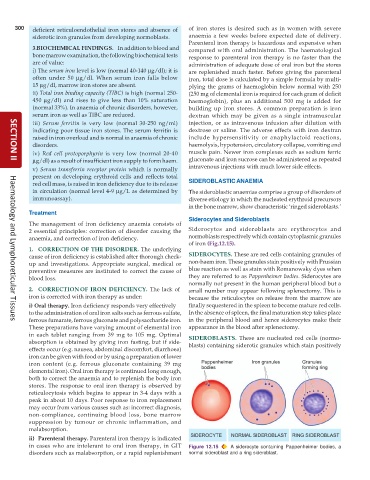
                                                               Siderocytes and Sideroblasts
           The management of iron deficiency anaemia consists of
           2 essential principles: correction of disorder causing the  Siderocytes and sideroblasts are erythrocytes and
           anaemia, and correction of iron deficiency.         normoblasts respectively which contain cytoplasmic granules
                                                               of iron (Fig.12.15).
           1. CORRECTION OF THE DISORDER. The underlying
           cause of iron deficiency is established after thorough check-  SIDEROCYTES. These are red cells containing granules of
           up and investigations. Appropriate surgical, medical or  non-haem iron. These granules stain positively with Prussian
           preventive measures are instituted to correct the cause of  blue reaction as well as stain with Romanowsky dyes when
           blood loss.                                         they are referred to as Pappenheimer bodies. Siderocytes are
                                                               normally not present in the human peripheral blood but a
           2. CORRECTIONOF IRON DEFICIENCY.  The lack of       small number may appear following splenectomy. This is
           iron is corrected with iron therapy as under:       because the reticulocytes on release from the marrow are
           i) Oral therapy. Iron deficiency responds very effectively  finally sequestered in the spleen to become mature red cells.
           to the administration of oral iron salts such as ferrous sulfate,  In the absence of spleen, the final maturation step takes place
           ferrous fumarate, ferrous gluconate and polysaccharide iron.  in the peripheral blood and hence siderocytes make their
     Haematology and Lymphoreticular Tissues
           These preparations have varying amount of elemental iron  appearance in the blood after splenectomy.
           in each tablet ranging from 39 mg to 105 mg. Optimal  SIDEROBLASTS.  These are nucleated red cells (normo-
           absorption is obtained by giving iron fasting, but if side-  blasts) containing siderotic granules which stain positively
           effects occur (e.g. nausea, abdominal discomfort, diarrhoea)
           iron can be given with food or by using a preparation of lower
           iron content (e.g. ferrous gluconate containing 39 mg
           elemental iron). Oral iron therapy is continued long enough,
           both to correct the anaemia and to replenish the body iron
           stores. The response to oral iron therapy is observed by
           reticulocytosis which begins to appear in 3-4 days with a
           peak in about 10 days. Poor response to iron replacement
           may occur from various causes such as: incorrect diagnosis,
           non-compliance, continuing blood loss, bone marrow
           suppression by tumour or chronic inflammation, and
           malabsorption.
           ii) Parenteral therapy. Parenteral iron therapy is indicated
           in cases who are intolerant to oral iron therapy, in GIT  Figure 12.15  A siderocyte containing Pappenheimer bodies, a
           disorders such as malabsorption, or a rapid replenishment  normal sideroblast and a ring sideroblast.

