


Page 320 - Textbook of Pathology, 6th Edition
P. 320
304 thus, the humans are entirely dependent upon dietary
           sources. The average daily requirement for vitamin B  is
                                                         12
           2-4 μg.
           ABSORPTION.  After ingestion, vitamin B  in food is
                                                  12
           released and forms a stable complex with gastric R-binder.
           R-binder is a form of glycoprotein found in various secretions
           (e.g. saliva, milk, gastric juice, bile), phagocytes and plasma.
           On entering the duodenum, the vitamin B -R-binder
                                                   12
           complex is digested releasing vitamin B  which then binds
                                            12
           to intrinsic factor (IF). The IF is a glycoprotein of molecular
           weight 50,000 produced by the parietal cells of the stomach
           and its secretion roughly parallels that of hydrochloric acid.
           The vitamin B -IF complex, on reaching the distal ileum,
                       12
           binds to the specific receptors on the mucosal brush border,
           thereby enabling the vitamin to be absorbed. The IF,
           therefore, acts as cell-directed carrier protein similar to
           transferrin. The receptor-bound vitamin B -IF complex is
                                               12
           taken into the ileal mucosal cells where after several hours
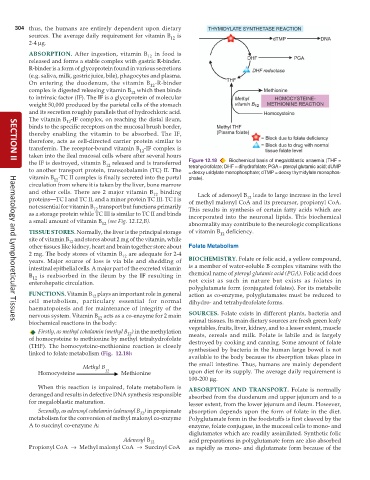
           the IF is destroyed, vitamin B  released and is transferred  Figure 12.18  Biochemical basis of megaloblastic anaemia (THF =
     SECTION II
                                    12
           to another transport protein, transcobalamin (TC) II. The  tetrahydrofolate; DHF = dihydrofolate; PGA = pteroyl glutamic acid; dUMP
                                                               = deoxy uridylate monophosphate; dTMP = deoxy thymidylate monophos-
           vitamin B -TC II complex is finally secreted into the portal  phate).
                   12
           circulation from where it is taken by the liver, bone marrow
           and other cells. There are 2 major vitamin B  binding  Lack of adenosyl B  leads to large increase in the level
                                                    12
                                                                                   12
           proteins—TC I and TC II, and a minor protein TC III. TC I is  of methyl malonyl CoA and its precursor, propionyl CoA.
           not essential for vitamin B  transport but functions primarily  This results in synthesis of certain fatty acids which are
                                12
           as a storage protein while TC III is similar to TC II and binds  incorporated into the neuronal lipids. This biochemical
           a small amount of vitamin B  (see Fig. 12.12,B).    abnormality may contribute to the neurologic complications
                                   12
           TISSUE STORES. Normally, the liver is the principal storage  of vitamin B  deficiency.
                                                                          12
           site of vitamin B  and stores about 2 mg of the vitamin, while
                        12
           other tissues like kidney, heart and brain together store about  Folate Metabolism
           2 mg. The body stores of vitamin B  are adequate for 2-4
                                         12
           years. Major source of loss is via bile and shedding of  BIOCHEMISTRY. Folate or folic acid, a yellow compound,
           intestinal epithelial cells. A major part of the excreted vitamin  is a member of water-soluble B complex vitamins with the
           B  is reabsorbed in the ileum by the IF resulting in  chemical name of pteroyl glutamic acid (PGA). Folic acid does
            12
           enterohepatic circulation.                          not exist as such in nature but exists as folates in
                                                               polyglutamate form (conjugated folates). For its metabolic
           FUNCTIONS. Vitamin B  plays an important role in general  action as co-enzyme, polyglutamates must be reduced to
                               12
           cell metabolism, particulary essential for normal   dihydro- and tetrahydrofolate forms.
           haematopoiesis and for maintenance of integrity of the
           nervous system. Vitamin B  acts as a co-enzyme for 2 main  SOURCES.  Folate exists in different plants, bacteria and
                                 12
           biochemical reactions in the body:                  animal tissues. Its main dietary sources are fresh green leafy
     Haematology and Lymphoreticular Tissues
              Firstly, as methyl cobalamin (methyl B ) in the methylation  vegetables, fruits, liver, kidney, and to a lesser extent, muscle
                                           12
           of homocysteine to methionine by methyl tetrahydrofolate  meats, cereals and milk. Folate is labile and is largely
                                                               destroyed by cooking and canning. Some amount of folate
           (THF). The homocysteine-methionine reaction is closely  synthesised by bacteria in the human large bowel is not
           linked to folate metabolism (Fig.  12.18):
                                                               available to the body because its absorption takes place in
                                                               the small intestine. Thus, humans are mainly dependent
                            Methyl B
              Homocysteine          12    Methionine           upon diet for its supply. The average daily requirement is
                                                               100-200 μg.
              When this reaction is impaired, folate metabolism is  ABSORPTION  AND TRANSPORT.  Folate is normally
           deranged and results in defective DNA synthesis responsible  absorbed from the duodenum and upper jejunum and to a
           for megaloblastic maturation.                       lesser extent, from the lower jejunum and ileum. However,
              Secondly, as adenosyl cobalamin (adenosyl B ) in propionate  absorption depends upon the form of folate in the diet.
                                               12
           metabolism for the conversion of methyl malonyl co-enzyme  Polyglutamate form in the foodstuffs is first cleaved by the
           A to succinyl co-enzyme A:                          enzyme, folate conjugase, in the mucosal cells to mono- and
                                                               diglutamates which are readily assimilated. Synthetic folic
                                          Adenosyl B 12        acid preparations in polyglutamate form are also absorbed
           Propionyl CoA → Methyl malonyl CoA → Succinyl CoA   as rapidly as mono- and diglutamate form because of the

