


Page 333 - Textbook of Pathology, 6th Edition
P. 333
317


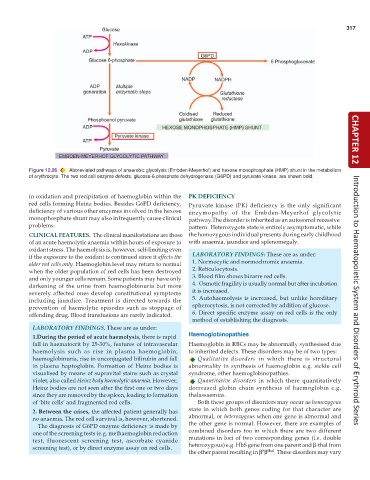
           Figure 12.26  Abbreviated pathways of anaerobic glycolysis (Embden-Meyerhof) and hexose monophosphate (HMP) shunt in the metabolism  CHAPTER 12
           of erythrocyte. The two red cell enzyme defects, glucose-6 phosphate dehydrogenase (G6PD) and pyruvate kinase, are shown bold.


           in oxidation and precipitation of haemoglobin within the  PK DEFICIENCY
           red cells forming Heinz bodies. Besides G6PD deficiency,  Pyruvate kinase (PK) deficiency is the only significant
           deficiency of various other enzymes involved in the hexose  enzymopathy of the Embden-Meyerhof glycolytic
           monophosphate shunt may also infrequently cause clinical  pathway.The disorder is inherited as an autosomal recessive
           problems.                                           pattern. Heterozygote state is entirely asymptomatic, while
           CLINICAL FEATURES.  The clinical manifestations are those  the homozygous individual presents during early childhood
           of an acute haemolytic anaemia within hours of exposure to  with anaemia, jaundice and splenomegaly.
           oxidant stress. The haemolysis is, however, self-limiting even
           if the exposure to the oxidant is continued since it affects the  LABORATORY FINDINGS: These are as under:
           older red cells only. Haemoglobin level may return to normal  1. Normocytic and normochromic anaemia.
           when the older population of red cells has been destroyed  2. Reticulocytosis.
           and only younger cells remain. Some patients may have only  3. Blood film shows bizarre red cells.
           darkening of the urine from haemoglobinuria but more  4.  Osmotic fragility is usually normal but after incubation
           severely affected ones develop constitutional symptoms  it is increased.
           including jaundice. Treatment is directed towards the  5. Autohaemolysis is increased, but unlike hereditary  Introduction to Haematopoietic System and Disorders of Erythroid Series
           prevention of haemolytic episodes such as stoppage of  spherocytosis, is not corrected by addition of glucose.
           offending drug. Blood transfusions are rarely indicated.  6. Direct specific enzyme assay on red cells is the only
                                                                 method of establishing the diagnosis.
            LABORATORY FINDINGS. These are as under:
            1.During the period of acute haemolysis, there is rapid  Haemoglobinopathies
            fall in haematocrit by 25-30%, features of intravascular  Haemoglobin in RBCs may be abnormally synthesised due
            haemolysis such as rise in plasma haemoglobin,     to inherited defects. These disorders may be of two types:
            haemoglobinuria, rise in unconjugated bilirubin and fall  Qualitative disorders in which there is structural
            in plasma haptoglobin. Formation of Heinz bodies is  abnormality in synthesis of haemoglobin e.g. sickle cell
            visualised by means of supravital stains such as crystal  syndrome, other haemoglobinopathies.
            violet, also called Heinz body haemolytic anaemia. However,  Quantitative disorders in which there quantitatively
            Heinz bodies are not seen after the first one or two days  decreased globin chain synthesis of haemoglobin e.g.
            since they are removed by the spleen, leading to formation  thalassaemias.
            of ‘bite cells’ and fragmented red cells.             Both these groups of disorders may occur as homozygous
            2. Between the crises, the affected patient generally has  state in which both genes coding for that character are
            no anaemia. The red cell survival is, however, shortened.  abnormal, or heterozygous when one gene is abnormal and
              The diagnosis of G6PD enzyme deficiency is made by  the other gene is normal. However, there are examples of
            one of the screening tests (e.g. methaemoglobin reduction  combined disorders too in which there are two different
            test, fluorescent screening test, ascorbate cyanide  mutations in loci of two corresponding genes (i.e. double
            screening test), or by direct enzyme assay on red cells.  heterozygous) e.g. HbS gene from one parent and β-thal from
                                                                                        S thal
                                                               the other parent resulting in β β  . These disorders may vary

