


Page 334 - Textbook of Pathology, 6th Edition
P. 334
318                                                      Patients with HbS are relatively protected against falciparum
                                                               malaria. Sickle syndromes occur in 3 different forms:
                                                               1. As heterozygous state for HbS: sickle cell trait (AS).
                                                               2. As homozygous state for HbS: sickle cell anaemia (SS).
                                                               3. As double heterozygous states e.g. sickle β-thalassaemia,
                                                               sickle-C disease (SC), sickle-D disease (SD).

                                                               Heterozygous State:Sickle Cell Trait
                                                               Sickle cell trait (AS) is a benign heterozygous state of HbS in
                                                               which only one abnormal gene is inherited. Patients with
                                                               AS develop no significant clinical problems except when they
                                                               become severely hypoxic and may develop sickle cell crises.

                                                                 LABORATORY FINDINGS.  These patients have no
                                                                 anaemia and have normal appearance of red cells. But in
                                                                 hypoxic crisis, sickle cell crises develop. The diagnosis is
           Figure 12.27  The geographic distribution of major haemo-  made by 2 tests:
           globinopathies and thalassaemias. Thalassaemia and HbD are the  1. Demonstration of sickling done under condition of
           haemoglobin disorders common in India.
                                                                 reduced oxygen tension by an oxygen consuming reagent,
     SECTION II
                                                                 sodium metabisulfite.
           in presentation from asymptomatic laboratory abnormalities
           to intrauterine death.                                2. Haemoglobin electrophoresis reveals 35-40% of the total
              There are geographic variations in the distribution of  haemoglobin as HbS.
           various haemoglobinopathies world over as shown in  Homozygous State:Sickle Cell Anaemia
           Fig. 12.27.  Major examples of these disorders are described
           below.                                              Sickle cell anaemia (SS) is a homozygous state of HbS in the
                                                               red cells in which an abnormal gene is inherited from each
                                                               parent. SS is a severe disorder associated with protean clinical
           STRUCTURALLY ABNORMAL HAEMOGLOBINS
                                                               manifestations and decreased life expectancy.
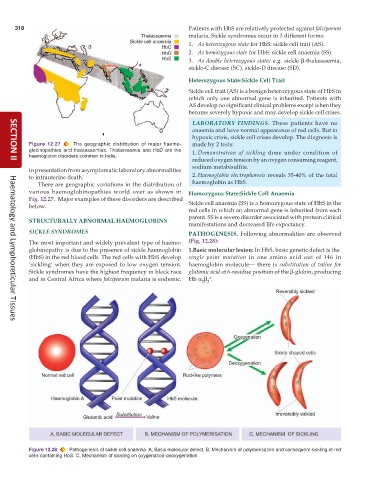
           SICKLE SYNDROMES                                    PATHOGENESIS. Following abnormalities are observed
           The most important and widely prevalent type of haemo-  (Fig. 12.28):
           globinopathy is due to the presence of sickle haemoglobin  1.Basic molecular lesion: In HbS, basic genetic defect is the
           (HbS) in the red blood cells. The red cells with HbS develop  single point mutation in one amino acid out of 146 in
           ‘sickling’ when they are exposed to low oxygen tension.  haemoglobin molecule— there is  substitution of valine for
           Sickle syndromes have the highest frequency in black race  glutamic acid at 6-residue position of the β-globin, producing
           and in Central Africa where falciparum malaria is endemic.  Hb α β .
                                                                      s
                                                                    2 2


     Haematology and Lymphoreticular Tissues


           Figure 12.28  Pathogenesis of sickle cell anaemia. A, Basic molecular defect. B, Mechanism of polymerisation and consequent sickling of red
           cells containing HbS. C, Mechanism of sickling on oxygenation-deoxygenation.

