


Page 339 - Textbook of Pathology, 6th Edition
P. 339
β β β β β-Thalassaemia Major                         323
                                                               β-thalassaemia major, also termed Mediterranean or Cooley’s
                                                               anaemia is the most common form of congenital haemolytic
                                                               anaemia. β-thalassaemia major is a homozygous state with
                                                               either complete absence of β-chain synthesis (β° thalassaemia
                                                                                                            +
                                                               major) or only small amounts of β-chains are formed (β  thalas-
                                                               saemia major). These result in excessive formation of alternate
                                                               haemoglobins, HbF (α  γ ) and HbA  (α  δ ).
                                                                                                   2
                                                                                  2 2
                                                                                                 2
                                                                                              2
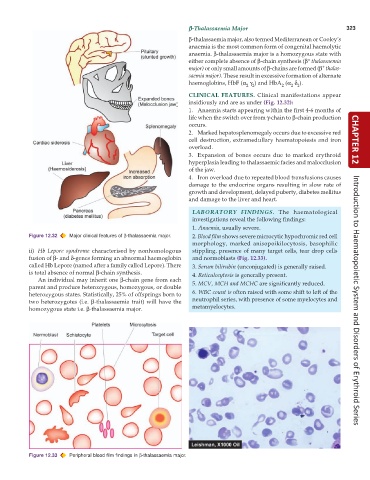
                                                               CLINICAL  FEATURES. Clinical manifestations appear
                                                               insidiously and are as under (Fig. 12.32):
                                                               1. Anaemia starts appearing within the first 4-6 months of
                                                               life when the switch over from γ-chain to β-chain production
                                                               occurs.
                                                               2. Marked hepatosplenomegaly occurs due to excessive red
                                                               cell destruction, extramedullary haematopoiesis and iron  CHAPTER 12
                                                               overload.
                                                               3. Expansion of bones occurs due to marked erythroid
                                                               hyperplasia leading to thalassaemic facies and malocclusion
                                                               of the jaw.
                                                               4. Iron overload due to repeated blood transfusions causes
                                                               damage to the endocrine organs resulting in slow rate of
                                                               growth and development, delayed puberty, diabetes mellitus
                                                               and damage to the liver and heart.

                                                                 LABORATORY FINDINGS. The haematological
                                                                 investigations reveal the following findings:
                                                                 1. Anaemia, usually severe.
           Figure 12.32  Major clinical features of β-thalassaemia major.  2. Blood film shows severe microcytic hypochromic red cell
                                                                 morphology, marked anisopoikilocytosis, basophilic
           ii) Hb Lepore syndrome characterised by nonhomologous  stippling, presence of many target cells, tear drop cells
           fusion of β- and δ-genes forming an abnormal haemoglobin  and normoblasts (Fig. 12.33).
           called Hb Lepore (named after a family called Lepore). There  3. Serum bilirubin (unconjugated) is generally raised.
           is total absence of normal β-chain synthesis.         4. Reticulocytosis is generally present.
              An individual may inherit one β-chain gene from each
           parent and produce heterozygous, homozygous, or double  5. MCV, MCH and MCHC are significantly reduced.
           heterozygous states. Statistically, 25% of offsprings born to  6. WBC count is often raised with some shift to left of the
           two heterozygotes (i.e.  β-thalassaemia trait) will have the  neutrophil series, with presence of some myelocytes and  Introduction to Haematopoietic System and Disorders of Erythroid Series
           homozygous state i.e. β-thalassaemia major.           metamyelocytes.


           Figure 12.33  Peripheral blood film findings in β-thalassaemia major.

