


Page 391 - Textbook of Pathology, 6th Edition
P. 391
375
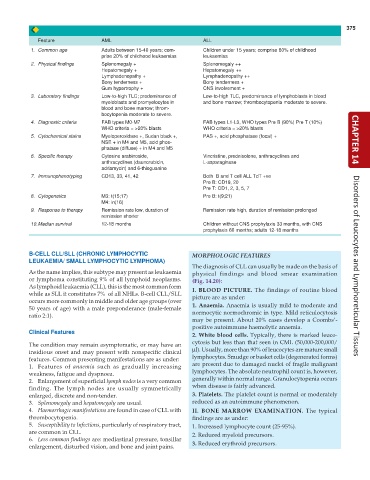
TABLE 14.12: Contrasting Features of AML and ALL.
Feature AML ALL
1. Common age Adults between 15-40 years; com- Children under 15 years; comprise 80% of childhood
prise 20% of childhood leukaemias leukaemias
2. Physical findings Splenomegaly + Splenomegaly ++
Hepatomegaly + Hepatomegaly ++
Lymphadenopathy + Lymphadenopathy ++
Bony tenderness + Bony tenderness +
Gum hypertrophy + CNS involvement +
3. Laboratory findings Low-to-high TLC; predominance of Low-to-high TLC, predominance of lymphoblasts in blood
myeloblasts and promyelocytes in and bone marrow; thrombocytopenia moderate to severe.
blood and bone marrow; throm-
bocytopenia moderate to severe.
4. Diagnostic criteria FAB types M0-M7 FAB types L1-L3, WHO types Pre B (90%) Pre T (10%)
WHO criteria = >20% blasts WHO criteria = >20% blasts
5. Cytochemical stains Myeloperoxidase +, Sudan black +, PAS +, acid phosphatase (focal) +
NSE + in M4 and M5, acid phos- CHAPTER 14
phatase (diffuse) + in M4 and M5
6. Specific therapy Cytosine arabinoside, Vincristine, prednisolone, anthracyclines and
anthracyclines (daunorubicin, L-asparaginase
adriamycin) and 6-thioguanine
7. Immunophenotyping CD13, 33, 41, 42 Both B and T cell ALL TdT +ve
Pre B: CD19, 20
Pre T: CD1, 2, 3, 5, 7
8. Cytogenetics M3: t(15;17) Pre B: t(9;21)
M4: in(16)
9. Response to therapy Remission rate low, duration of Remission rate high, duration of remission prolonged
remission shorter
10.Median survival 12-18 months Children without CNS prophylaxis 33 months, with CNS
prophylaxis 60 months; adults 12-18 months
B-CELL CLL/SLL (CHRONIC LYMPHOCYTIC MORPHOLOGIC FEATURES
LEUKAEMIA/ SMALL LYMPHOCYTIC LYMPHOMA)
The diagnosis of CLL can usually be made on the basis of Disorders of Leucocytes and Lymphoreticular Tissues
As the name implies, this subtype may present as leukaemia physical findings and blood smear examination
or lymphoma constituting 9% of all lymphoid neoplasms. (Fig. 14.20):
As lymphoid leukaemia (CLL), this is the most common form I. BLOOD PICTURE. The findings of routine blood
while as SLL it constitutes 7% of all NHLs. B-cell CLL/SLL picture are as under:
occurs more commonly in middle and older age groups (over
50 years of age) with a male preponderance (male-female 1. Anaemia. Anaemia is usually mild to moderate and
ratio 2:1). normocytic normochromic in type. Mild reticulocytosis
may be present. About 20% cases develop a Coombs’-
positive autoimmune haemolytic anaemia.
Clinical Features
2. White blood cells. Typically, there is marked leuco-
The condition may remain asymptomatic, or may have an cytosis but less than that seen in CML (50,000-200,000/
insidious onset and may present with nonspecific clinical μl). Usually, more than 90% of leucocytes are mature small
features. Common presenting manifestations are as under: lymphocytes. Smudge or basket cells (degenerated forms)
1. Features of anaemia such as gradually increasing are present due to damaged nuclei of fragile malignant
weakness, fatigue and dyspnoea. lymphocytes. The absolute neutrophil count is, however,
2. Enlargement of superficial lymph nodes is a very common generally within normal range. Granulocytopenia occurs
finding. The lymph nodes are usually symmetrically when disease is fairly advanced.
enlarged, discrete and non-tender. 3. Platelets. The platelet count is normal or moderately
3. Splenomegaly and hepatomegaly are usual. reduced as an autoimmune phenomenon.
4. Haemorrhagic manifestations are found in case of CLL with II. BONE MARROW EXAMINATION. The typical
thrombocytopenia. findings are as under:
5. Susceptibility to Infections, particularly of respiratory tract, 1. Increased lymphocyte count (25-95%).
are common in CLL. 2. Reduced myeloid precursors.
6. Less common findings are: mediastinal pressure, tonsillar
enlargement, disturbed vision, and bone and joint pains. 3. Reduced erythroid precursors.

