


Page 390 - Textbook of Pathology, 6th Edition
P. 390
374


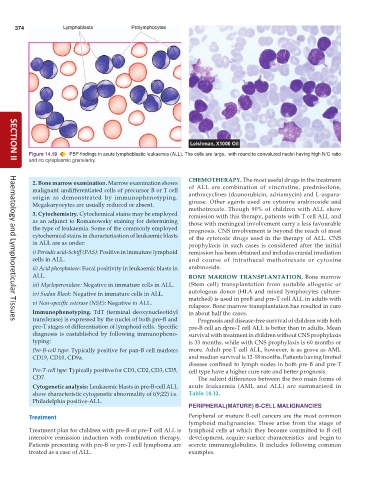
           Figure 14.19  PBF findings in acute lymphoblastic leukaemia (ALL). The cells are large,  with round to convoluted nuclei having high N/C ratio
           and no cytoplasmic granularity.
     SECTION II

                                                               CHEMOTHERAPY. The most useful drugs in the treatment
            2. Bone marrow examination. Marrow examination shows
            malignant undifferentiated cells of precursor B or T cell  of ALL are combination of vincristine, prednisolone,
            origin as demonstrated by immunophenotyping.       anthracyclines (daunorubicin, adriamycin) and L-aspara-
            Megakaryocytes are usually reduced or absent.      ginase. Other agents used are cytosine arabinoside and
                                                               methotrexate. Though 90% of children with ALL show
            3. Cytochemistry. Cytochemical stains may be employed  remission with this therapy, patients with T cell ALL and
            as an adjunct to Romanowsky staining for determining  those with meningeal involvement carry a less favourable
            the type of leukaemia. Some of the commonly employed  prognosis. CNS involvement is beyond the reach of most
            cytochemical stains in characterisation of leukaemic blasts  of the cytotoxic drugs used in the therapy of ALL. CNS
            in ALL are as under:                               prophylaxis in such cases is considered after the initial
            i) Periodic acid-Schiff (PAS): Positive in immature lymphoid  remission has been obtained and includes cranial irradiation
            cells in ALL.                                      and course of intrathecal methotrexate or cytosine
            ii) Acid phosphatase: Focal positivity in leukaemic blasts in  arabinoside.
            ALL.                                               BONE MARROW TRANSPLANTATION.  Bone marrow
            iii) Myeloperoxidase: Negative in immature cells in ALL.  (Stem cell) transplantation from suitable allogenic or
            iv) Sudan Black: Negative in immature cells in ALL.  autologous donor (HLA and mixed lymphocytes culture-
                                                               matched) is used in preB and pre-T cell ALL in adults with
            v) Non-specific esterase (NSE): Negative in ALL.
                                                               relapses. Bone marrow transplantation has resulted in cure
            Immunophenotyping. TdT (terminal deoxynucleotidyl  in about half the cases.
            transferase) is expressed by the nuclei of both pre-B and  Prognosis and disease-free survival of children with both
     Haematology and Lymphoreticular Tissues
            pre-T stages of differentiation of lymphoid cells.  Specific  pre-B cell an dpre-T cell ALL is better than in adults. Mean
            diagnosis is eastablished by following immunopheno-  survival with treatment in children without CNS prophylaxis
            typing:                                            is 33 months, while with CNS prophylaxis is 60 months or
            Pre-B-cell type: Typically positive for pan-B cell markers  more. Adult pre-T cell ALL, however, is as grave as AML
            CD19, CD10, CD9a.                                  and median survival is 12-18 months. Patients having limited
                                                               disease confined to lymph nodes in both pre-B and pre-T
            Pre-T-cell type: Typically positive for CD1, CD2, CD3, CD5,  cell type have a higher cure rate and better prognosis.
            CD7.                                                  The salient differences between the two main forms of
            Cytogenetic analysis: Leukaemic blasts in pre-B-cell ALL  acute leukaemia (AML and ALL) are summarised in
            show characteristic cytogenetic abnormality of t(9;22) i.e.  Table 14.12.
            Philadelphia positive-ALL.
                                                               PERIPHERAL(MATURE) B-CELL MALIGNANCIES
           Treatment                                           Peripheral or mature B-cell cancers are the most common
                                                               lymphoid malignancies. These arise from the stage of
           Treatment plan for children with pre-B or pre-T cell ALL is  lymphoid cells at which they become committed to B cell
           intensive remission induction with combination therapy.  development, acquire surface characteristics  and begin to
           Patients presenting with pre-B or pre-T cell lymphoma are  secrete immunoglobulins. It includes following common
           treated as a case of ALL.                           examples.

