


Page 454 - Textbook of Pathology, 6th Edition
P. 454
438 from disorders of the lungs. It is characterised by right        RHEUMATIC FEVER AND
           ventricular dilatation or hypertrophy, or both. Thus, cor
           pulmonale is the right-sided counterpart of the hypertensive  RHEUMATIC HEART DISEASE
           heart disease described above.
              Depending upon the rapidity of development, cor  DEFINITION
           pulmonale may be acute or chronic:                  Rheumatic fever (RF) is a systemic, post-streptococcal, non-
              Acute cor pulmonale occurs following massive pulmonary  suppurative inflammatory disease, principally affecting the
           embolism resulting in sudden dilatation of the pulmonary  heart, joints, central nervous system, skin and subcutaneous
           trunk, conus and right ventricle.                   tissues. The chronic stage of RF involves all the layers of the
              Chronic cor pulmonale is more common and is often  heart (pancarditis) causing major cardiac sequelae referred
           preceded by chronic pulmonary hypertension (Chapter 17).  to as rheumatic heart disease (RHD). In spite of its name
           Following chronic lung diseases can cause chronic   suggesting an acute arthritis migrating from joint to joint, it
           pulmonary hypertension and subsequent cor pulmonale:  is well known that it is the heart rather than the joints which
            i) Chronic emphysema                               is first and major organ affected. William Boyd years ago
            ii) Chronic bronchitis                             gave the dictum ‘rheumatism licks the joint, but bites the whole
           iii) Pulmonary tuberculosis                         heart’.
           iv) Pneumoconiosis
            v) Cystic fibrosis                                 INCIDENCE
           vi) Hyperventilation in marked obesity (Pickwickian  The disease appears most commonly in children between
               syndrome)                                       the age of 5 to 15 years when the streptococcal infection is
           vii) Multiple organised pulmonary emboli.           most frequent and intense. Both the sexes are affected equally,
           PATHOGENESIS. Chronic lung diseases as well as diseases  though some investigators have noted a slight female
           of the pulmonary vessels cause increased pulmonary  preponderance.
           vascular resistance. The most common underlying        The geographic distribution, incidence and severity of
           mechanism causing increased pulmonary blood pressure  RF and RHD are generally related to the frequency and
           (pulmonary hypertension) is by pulmonary vasoconstriction,  severity of streptococcal pharyngeal infection. The disease
           activation of coagulation pathway and obliteration of  is seen more commonly in poor socioeconomic strata of the
           pulmonary arterial vessels. Pulmonary hypertension causes  society living in damp and overcrowded places which
     SECTION III
           pressure overload on the right ventricle and hence right  promote interpersonal spread of the streptococcal infection.
           ventricular enlargement. Initially, there is right ventricular  Its incidence has declined in the developed countries as a
           hypertrophy, but as cardiac decompensation sets in and right  result of improved living conditions and early use of
           heart failure ensues, dilatation of right ventricle occurs.  antibiotics in streptococcal infection. But it is still common
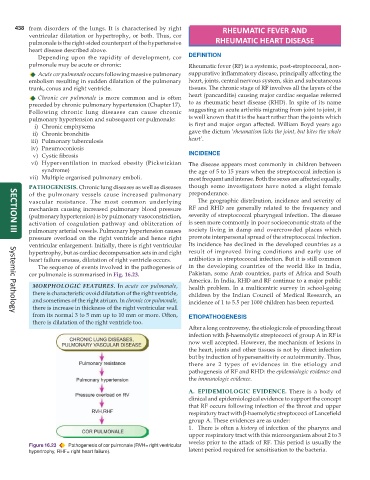
              The sequence of events involved in the pathogenesis of  in the developing countries of the world like in India,
           cor pulmonale is summarised in Fig. 16.23.          Pakistan, some Arab countries, parts of Africa and South
                                                               America. In India, RHD and RF continue to a major public
            MORPHOLOGIC FEATURES. In acute cor pulmonale,      health problem. In a multicentric survey in school-going
            there is characteristic ovoid dilatation of the right ventricle,  children by the Indian Council of Medical Research, an
            and sometimes of the right atrium. In chronic cor pulmonale,  incidence of 1 to 5.5 per 1000 children has been reported.
            there is increase in thickness of the right ventricular wall
            from its normal 3 to 5 mm up to 10 mm or more. Often,  ETIOPATHOGENESIS
     Systemic Pathology
            there is dilatation of the right ventricle too.
                                                               After a long controversy, the etiologic role of preceding throat
                                                               infection with β-haemolytic streptococci of group A in RF is
                                                               now well accepted. However, the mechanism of lesions in
                                                               the heart, joints and other tissues is not by direct infection
                                                               but by induction of hypersensitivity or autoimmunity. Thus,
                                                               there are 2 types of evidences in the etiology and
                                                               pathogenesis of RF and RHD: the epidemiologic evidence and
                                                               the immunologic evidence.
                                                               A. EPIDEMIOLOGIC EVIDENCE. There is a body of
                                                               clinical and epidemiological evidence to support the concept
                                                               that RF occurs following infection of the throat and upper
                                                               respiratory tract with β-haemolytic streptococci of Lancefield
                                                               group A. These evidences are as under:
                                                               1. There is often a history of infection of the pharynx and
                                                               upper respiratory tract with this microorganism about 2 to 3
                                                               weeks prior to the attack of RF. This period is usually the
           Figure 16.23  Pathogenesis of cor pulmonale (RVH= right ventricular
           hypertrophy, RHF= right heart failure).             latent period required for sensitisation to the bacteria.

