


Page 639 - Textbook of Pathology, 6th Edition
P. 639
623


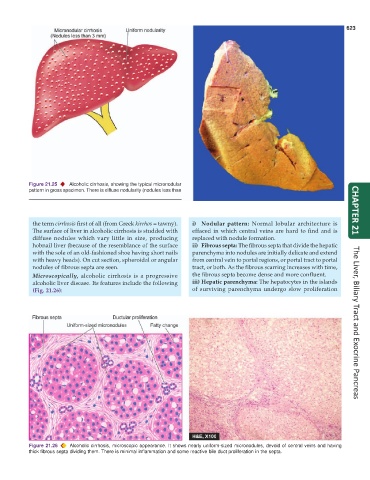
           Figure 21.25  Alcoholic cirrhosis, showing the typical micronodular
           pattern in gross specimen. There is diffuse nodularity (nodules less than
           3 mm diameter) on sectioned surface of the liver.


            the term cirrhosis first of all (from Greek kirrhos = tawny).  i) Nodular pattern: Normal lobular architecture is  CHAPTER 21
            The surface of liver in alcoholic cirrhosis is studded with  effaced in which central veins are hard to find and is
            diffuse nodules which vary little in size, producing  replaced with nodule formation.
            hobnail liver (because of the resemblance of the surface  ii) Fibrous septa: The fibrous septa that divide the hepatic
            with the sole of an old-fashioned shoe having short nails  parenchyma into nodules are initially delicate and extend
            with heavy heads). On cut section, spheroidal or angular  from central vein to portal regions, or portal tract to portal
            nodules of fibrous septa are seen.                   tract, or both. As the fibrous scarring increases with time,
            Microscopically, alcoholic cirrhosis is a progressive  the fibrous septa become dense and more confluent.
            alcoholic liver disease. Its features include the following  iii) Hepatic parenchyma: The hepatocytes in the islands
            (Fig. 21.26):                                        of surviving parenchyma undergo slow proliferation   The Liver, Biliary Tract and Exocrine Pancreas


           Figure 21.26  Alcoholic cirrhosis, microscopic appearance. It shows nearly uniform-sized micronodules, devoid of central veins and having
           thick fibrous septa dividing them. There is minimal inflammation and some reactive bile duct proliferation in the septa.

