


Page 638 - Textbook of Pathology, 6th Edition
P. 638
622


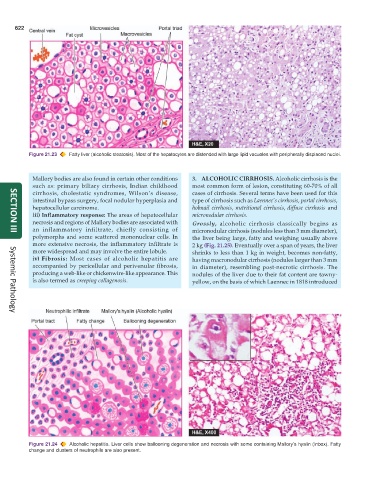
           Figure 21.23  Fatty liver (alcoholic steatosis). Most of the hepatocytes are distended with large lipid vacuoles with peripherally displaced nuclei.


            Mallory bodies are also found in certain other conditions  3. ALCOHOLIC CIRRHOSIS. Alcoholic cirrhosis is the
            such as: primary biliary cirrhosis, Indian childhood  most common form of lesion, constituting 60-70% of all
            cirrhosis, cholestatic syndromes, Wilson’s disease,  cases of cirrhosis. Several terms have been used for this
            intestinal bypass surgery, focal nodular hyperplasia and  type of cirrhosis such as Laennec’s cirrhosis, portal cirrhosis,
            hepatocellular carcinoma.                            hobnail cirrhosis, nutritional cirrhosis, diffuse cirrhosis and
            iii) Inflammatory response: The areas of hepatocellular  micronodular cirrhosis.
            necrosis and regions of Mallory bodies are associated with  Grossly, alcoholic cirrhosis classically begins as
            an inflammatory infiltrate, chiefly consisting of    micronodular cirrhosis (nodules less than 3 mm diameter),
     SECTION III
            polymorphs and some scattered mononuclear cells. In  the liver being large, fatty and weighing usually above
            more extensive necrosis, the inflammatory infiltrate is  2 kg (Fig. 21.25). Eventually over a span of years, the liver
            more widespread and may involve the entire lobule.   shrinks to less than 1 kg in weight, becomes non-fatty,
            iv) Fibrosis: Most cases of alcoholic hepatitis are  having macronodular cirrhosis (nodules larger than 3 mm
            accompanied by pericellular and perivenular fibrosis,  in diameter), resembling post-necrotic cirrhosis. The
            producing a web-like or chickenwire-like appearance. This  nodules of the liver due to their fat content are tawny-
            is also termed as creeping collagenosis.             yellow, on the basis of which Laennec in 1818 introduced


     Systemic Pathology


           Figure 21.24  Alcoholic hepatitis. Liver cells show ballooning degeneration and necrosis with some containing Mallory’s hyalin (Inbox). Fatty
           change and clusters of neutrophils are also present.

