


Page 637 - Textbook of Pathology, 6th Edition
P. 637
occurrence of gout, impaired gluconeogenesis and altered  621
                                                               steroid metabolism.
                                                               8. Retention of liver cell water and proteins. Alcohol is
                                                               inhibitory to secretion of newly-synthesised proteins by the
                                                               liver leading to their retention in the hepatocytes. Water is
                                                               simultaneously retained in the cell in proportion to the
                                                               protein and results in swelling of hepatocytes resulting in
                                                               hepatomegaly in alcoholics.
                                                               9. Hypoxia. Chronic ingestion of alcohol results in increased
                                                               oxygen demand by the liver resulting in a hypoxic state
                                                               which causes hepatocellular necrosis in centrilobular zone
                                                               (zone 3). Redox changes are also more marked in zone 3.
                                                               10. Increased liver fat. The origin of fat in the body was
                                                               discussed in Chapter 3 (page 37). In chronic alcoholism, there
                                                               is rise in the amount of fat available to the liver which could
                                                               be from exogenous (dietary) sources, excess mobilisation
                                                               from adipose tissue or increased lipid synthesis by the liver
                                                               itself. This may account for lipid accumulation in the
                                                               hepatocytes.

                                                                 MORPHOLOGIC FEATURES. Three types of morpho-
                                                                 logic lesions are described in alcoholic liver disease—
                                                                 alcoholic steatosis (fatty liver), alcoholic hepatitis and
                                                                 alcoholic cirrhosis.
                                                                 1. ALCOHOLIC  STEATOSIS (FATTY LIVER). The           CHAPTER 21
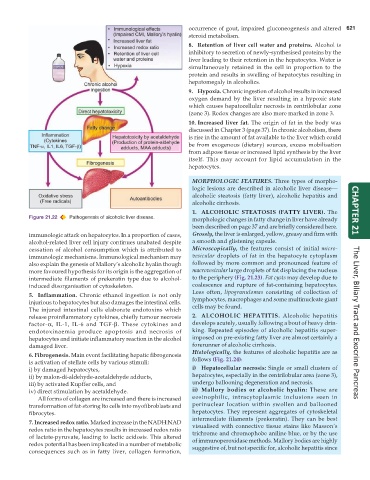
           Figure 21.22  Pathogenesis of alcoholic liver disease.  morphologic changes in fatty change in liver have already
                                                                 been described on page 37 and are briefly considered here.
           immunologic attack on hepatocytes. In a proportion of cases,  Grossly, the liver is enlarged, yellow, greasy and firm with
           alcohol-related liver cell injury continues unabated despite  a smooth and glistening capsule.
           cessation of alcohol consumption which is attributed to  Microscopically, the features consist of initial micro-
           immunologic mechanisms. Immunological mechanism may   vesicular droplets of fat in the hepatocyte cytoplasm
           also explain the genesis of Mallory’s alcoholic hyalin though  followed by more common and pronounced feature of
           more favoured hypothesis for its origin is the aggregation of  macrovesicular large droplets of fat displacing the nucleus
           intermediate filaments of prekeratin type due to alcohol-  to the periphery (Fig. 21.23). Fat cysts may develop due to
           induced disorganisation of cytoskeleton.              coalescence and rupture of fat-containing hepatocytes.
                                                                 Less often,  lipogranulomas consisting of collection of
           5. Inflammation.  Chronic ethanol ingestion is not only
           injurious to hepatocytes but also damages the intestinal cells.  lymphocytes, macrophages and some multinucleate giant
           The injured intestinal cells elaborate endotoxins which  cells may be found.
           release proinflammatory cytokines, chiefly tumour necrosis  2. ALCOHOLIC HEPATITIS. Alcoholic hepatitis
           factor-α, IL-1, IL-6 and TGF-β. These cytokines and   develops acutely, usually following a bout of heavy drin-  The Liver, Biliary Tract and Exocrine Pancreas
           endotoxinaemia produce apoptosis and necrosis of      king. Repeated episodes of alcoholic hepatitis super-
           hepatocytes and initiate inflammatory reaction in the alcohol  imposed on pre-existing fatty liver are almost certainly a
           damaged liver.                                        forerunner of alcoholic cirrhosis.
                                                                 Histologically, the features of alcoholic hepatitis are as
           6. Fibrogenesis. Main event facilitating hepatic fibrogenesis
           is activation of stellate cells by various stimuli:   follows (Fig. 21.24):
           i) by damaged hepatocytes,                            i) Hepatocellular necrosis: Single or small clusters of
           ii) by malon-di-aldehyde-acetaldehyde adducts,        hepatocytes, especially in the centrilobular area (zone 3),
           iii) by activated Kupffer cells, and                  undergo ballooning degeneration and necrosis.
           iv) direct stimulation by acetaldehyde.               ii) Mallory bodies or alcoholic hyalin: These are
              All forms of collagen are increased and there is increased  eosinophilic, intracytoplasmic inclusions seen in
           transformation of fat-storing lto cells into myofibroblasts and  perinuclear location within swollen and ballooned
           fibrocytes.                                           hepatocytes. They represent aggregates of cytoskeletal
                                                                 intermediate filaments (prekeratin). They can be best
           7. Increased redox ratio. Marked increase in the NADH:NAD  visualised with connective tissue stains like Masson’s
           redox ratio in the hepatocytes results in increased redox ratio  trichrome and chromophobe aniline blue, or by the use
           of lactate-pyruvate, leading to lactic acidosis. This altered  of immunoperoxidase methods. Mallory bodies are highly
           redox potential has been implicated in a number of metabolic  suggestive of, but not specific for, alcoholic hepatitis since
           consequences such as in fatty liver, collagen formation,

