


Page 710 - Textbook of Pathology, 6th Edition
P. 710
694 Grossly, it is a solitary, unilateral well demarcated tumour
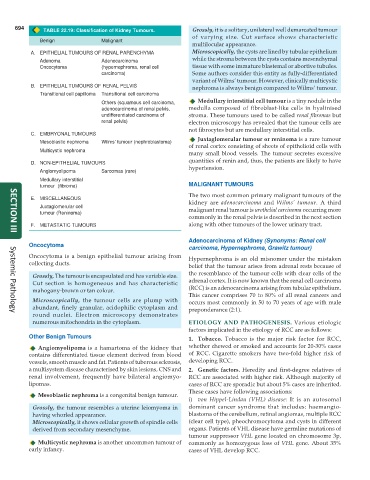
TABLE 22.19: Classification of Kidney Tumours.
of varying size. Cut surface shows characteristic
Benign Malignant
multilocular appearance.
A. EPITHELIAL TUMOURS OF RENAL PARENCHYMA Microscopically, the cysts are lined by tubular epithelium
while the stroma between the cysts contains mesenchymal
Adenoma Adenocarcinoma
Oncocytoma (hypernephroma, renal cell tissue with some immature blastemal or abortive tubules.
carcinoma) Some authors consider this entity as fully-differentiated
variant of Wilms’ tumour. However, clinically multicystic
B. EPITHELIAL TUMOURS OF RENAL PELVIS nephroma is always benign compared to Wilms’ tumour.
Transitional cell papilloma Transitional cell carcinoma
Others (squamous cell carcinoma, Medullary interstitial cell tumour is a tiny nodule in the
adenocarcinoma of renal pelvis, medulla composed of fibroblast-like cells in hyalinised
undifferentiated carcinoma of stroma. These tumours used to be called renal fibromas but
renal pelvis) electron microscopy has revealed that the tumour cells are
not fibrocytes but are medullary interstitial cells.
C. EMBRYONAL TUMOURS
Juxtaglomerular tumour or reninoma is a rare tumour
Mesoblastic nephroma Wilms’ tumour (nephroblastoma)
of renal cortex consisting of sheets of epithelioid cells with
Multicystic nephroma
many small blood vessels. The tumour secretes excessive
quantities of renin and, thus, the patients are likely to have
D. NON-EPITHELIAL TUMOURS
hypertension.
Angiomyolipoma Sarcomas (rare)
Medullary interstitial
tumour (fibroma) MALIGNANT TUMOURS
The two most common primary malignant tumours of the
E. MISCELLANEOUS
kidney are adenocarcinoma and Wilms’ tumour. A third
Juxtaglomerular cell malignant renal tumour is urothelial carcinoma occurring more
tumour (Reninoma)
commonly in the renal pelvis is described in the next section
F. METASTATIC TUMOURS along with other tumours of the lower urinary tract.
SECTION III
Adenocarcinoma of Kidney (Synonyms: Renal cell
Oncocytoma carcinoma, Hypernephroma, Grawitz tumour)
Oncocytoma is a benign epithelial tumour arising from Hypernephroma is an old misnomer under the mistaken
collecting ducts. belief that the tumour arises from adrenal rests because of
Grossly, The tumour is encapsulated and has variable size. the resemblance of the tumour cells with clear cells of the
Cut section is homogeneous and has characteristic adrenal cortex. It is now known that the renal cell carcinoma
mahogany-brown or tan colour. (RCC) is an adenocarcinoma arising from tubular epithelium.
This cancer comprises 70 to 80% of all renal cancers and
Microscopically, the tumour cells are plump with occurs most commonly in 50 to 70 years of age with male
abundant, finely granular, acidophilic cytoplasm and preponderance (2:1).
round nuclei. Electron microscopy demonstrates
Systemic Pathology
numerous mitochondria in the cytoplasm. ETIOLOGY AND PATHOGENESIS. Various etiologic
factors implicated in the etiology of RCC are as follows:
Other Benign Tumours 1. Tobacco. Tobacco is the major risk factor for RCC,
Angiomyolipoma is a hamartoma of the kidney that whether chewed or smoked and accounts for 20-30% cases
contains differentiated tissue element derived from blood of RCC. Cigarette smokers have two-fold higher risk of
vessels, smooth muscle and fat. Patients of tuberous sclerosis, developing RCC.
a multisystem disease characterised by skin lesions, CNS and 2. Genetic factors. Heredity and first-degree relatives of
renal involvement, frequently have bilateral angiomyo- RCC are associated with higher risk. Although majority of
lipomas. cases of RCC are sporadic but about 5% cases are inherited.
These cases have following associations:
Mesoblastic nephroma is a congenital benign tumour.
i) von Hippel-Lindau (VHL) disease: It is an autosomal
Grossly, the tumour resembles a uterine leiomyoma in dominant cancer syndrome that includes: haemangio-
having whorled appearance. blastoma of the cerebellum, retinal angiomas, multiple RCC
Microscopically, it shows cellular growth of spindle cells (clear cell type), pheochromocytoma and cysts in different
derived from secondary mesenchyme. organs. Patients of VHL disease have germline mutations of
tumour suppressor VHL gene located on chromosome 3p,
Multicystic nephroma is another uncommon tumour of commonly as homozygous loss of VHL gene. About 35%
early infancy. cases of VHL develop RCC.

