


Page 707 - Textbook of Pathology, 6th Edition
P. 707
Pathogenesis. The mechanism of calcium stone formation is  691
                                                               explained on the basis of imbalance between the degree of
                                                               supersaturation of the ions forming the stone and the
                                                               concentration of inhibitors in the urine. Most likely site where
                                                               the crystals of calcium oxalate and/or calcium phosphate
                                                               are precipitated is the tubular lining or around some
                                                               fragment of debris in the tubule acting as nidus of the stone.
                                                               The stone grows, as more and more crystals are deposited
                                                               around the nidus. A number of other predisposing factors
                                                               contributing to formation of calcium stones are alkaline
                                                               urinary pH, decreased urinary volume and increased
                                                               excretion of oxalate and uric acid.
                                                               Morphology. Calcium stones are usually small (less than a
                                                               centimeter), ovoid, hard, with granular rough surface. They
                                                               are dark brown due to old blood pigment deposited in them
                                                               as a result of repeated trauma caused to the urinary tract by
                                                               these sharp-edged stones.
                                                               2. MIXED (STRUVITE) STONES. About 15% of urinary
                                                               calculi are made of magnesium-ammonium-calcium
                                                               phosphate, often called struvite; hence mixed stones are also
                                                               called as ‘struvite stones’ or ‘triple phosphate stones’.
                                                               Etiology. Struvite stones are formed as a result of infection
                                                               of the urinary tract with urea-splitting organisms that
                                                               produce urease such as by species of Proteus, and occasionally
                                                               Klebsiella, Pseudomonas and Enterobacter. These are, therefore,  CHAPTER 22
                                                               also known as infection-induced stones. However, E. coli does
                                                               not form urease.
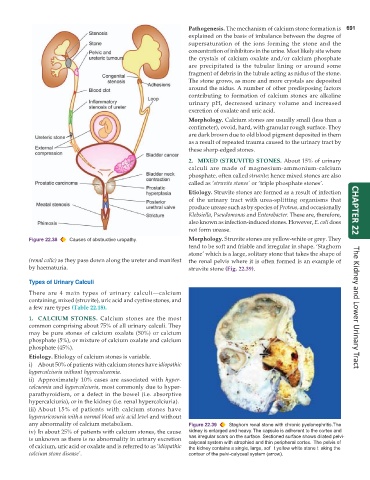
           Figure 22.38  Causes of obstructive uropathy.       Morphology. Struvite stones are yellow-white or grey. They
                                                               tend to be soft and friable and irregular in shape. ‘Staghorn
                                                               stone’ which is a large, solitary stone that takes the shape of
           (renal colic) as they pass down along the ureter and manifest  the renal pelvis where it is often formed is an example of
           by haematuria.                                      struvite stone (Fig. 22.39).


           Types of Urinary Calculi
           There are 4 main types of urinary calculi—calcium
           containing, mixed (struvite), uric acid and cystine stones, and
           a few rare types (Table 22.18).                                                                            The Kidney and Lower Urinary Tract
           1. CALCIUM STONES.  Calcium stones are the most
           common comprising about 75% of all urinary calculi. They
           may be pure stones of calcium oxalate (50%) or calcium
           phosphate (5%), or mixture of calcium oxalate and calcium
           phosphate (45%).
           Etiology. Etiology of calcium stones is variable.
           i) About 50% of patients with calcium stones have idiopathic
           hypercalciuria without hypercalcaemia.
           ii) Approximately 10% cases are associated with  hyper-
           calcaemia and hypercalciuria, most commonly due to hyper-
           parathyroidism, or a defect in the bowel (i.e. absorptive
           hypercalciuria), or in the kidney (i.e. renal hypercalciuria).
           iii) About 15% of patients with calcium stones have
           hyperuricosuria with a normal blood uric acid level and without
           any abnormality of calcium metabolism.              Figure 22.39  Staghorn renal stone with chronic pyelonephritis.The
           iv) In about 25% of patients with calcium stones, the cause  kidney is enlarged and heavy. The capsule is adherent to the cortex and
           is unknown as there is no abnormality in urinary excretion  has irregular scars on the surface. Sectioned surface shows dilated pelvi-
                                                               calyceal system with atrophied and thin peripheral cortex. The pelvis of
           of calcium, uric acid or oxalate and is referred to as ‘idiopathic  the kidney contains a single, large, sof t yellow white stone t aking the
           calcium stone disease’.                             contour of the pelvi-calyceal system (arrow).

