


Page 744 - Textbook of Pathology, 6th Edition
P. 744
728      In mild dysplasia (CIN-1), the abnormal cells extend up  worldwide cervical cancer remains third most common
            to one-third thickness from the basal to the surface layer;  cancer in women, next to breast and lung cancer. Although
               In moderate dysplasia (CIN-2) up to two-thirds;  accurate statistics are not available from India, but it is
               In severe dysplasia (CIN-3), these cells extend from 75-  perhaps the leading cause of death in women. In the Pap
            90% thickness of epithelium; and                   screening programme, patients having abnormal Pap smear
               In  carcinoma in situ  (included in CIN-3), the entire  are appropriately followed up and, therefore, it requires
            thickness from the basement membrane to the surface  understanding of the Bethesda system by the clinician as
            shows dysplastic cells.                            regards value and limitations of cytology reports prepared
                The atypical cells migrate to the surface layers from  by the cytologist/cytotechnician.
            where they are shed off (exfoliated) into vaginal secre-  Cervical screening recommendations include annual
            tions in Pap smear. The individual dysplastic or abnor-  cervical smear in all sexually active women having any risk
            mal cells in these grades of atypia show various cytologic  factors listed above. However, if three consecutive Pap
            changes such as: crowding of cells, pleomorphism, high  smears are negative in ‘high-risk women’ or satisfactory in
            nucleocytoplasmic ratio, coarse and irregular nuclear  ‘low risk women’, frequency of Pap screening is reduced.
            chromatin, numerous mitoses and scattered dyskaryotic  There is no upper age limit for cervical screening.
            cells.                                                The broad principles of the Bethesda system of cytologic
                                                               evaluation are as under:
               The diagnosis of dysplasia and carcinoma in situ or CIN/  Pap smears are evaluated as regards adequacy of specimen
           SIL is best made by exfoliative cytologic studies discussed in  i.e. satisfactory for evaluation, satisfactory but limited, or
           Chapter 11. The degree of atypicality in the exfoliated surface  unsatisfactory for evaluation giving reason.
           epithelial cells can be objectively graded on the basis of 3  General diagnosis is given in the form of normal or
           principal features (Fig. 24.5,B):                   abnormal smear.
           1. More severe nuclear dyskaryotic changes such as     Descriptive diagnosis is given in abnormal smears that
           increased hyperchromasia and nuclear membrane folding.  includes: benign cellular changes, reactive cellular changes,
           2. Decreased cytoplasmic maturation i.e. less cytoplasm as  and abnormalities of epithelial cells.
           the surface cells show less maturation.                Cellular abnormalities include:  ASCUS (atypical
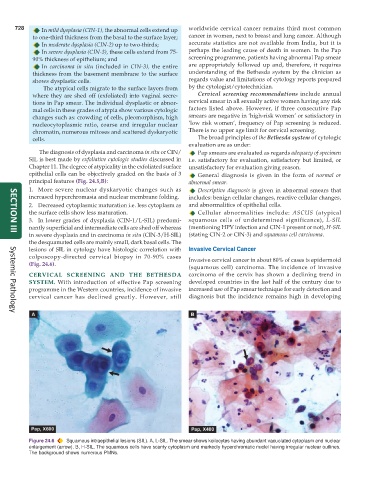
           3. In lower grades of dysplasia (CIN-1/L-SIL) predomi-  squamous cells of undetermined significance), L-SIL
           nantly superficial and intermediate cells are shed off whereas  (mentioning HPV infection and CIN-1 present or not), H-SIL
           in severe dysplasia and in carcinoma in situ (CIN-3/H-SIL)  (stating CIN-2 or CIN-3) and squamous cell carcinoma.
     SECTION III
           the desquamated cells are mainly small, dark basal cells. The
           lesions of SIL in cytology have histologic correlation with  Invasive Cervical Cancer
           colposcopy-directed cervical biopsy in 70-90% cases  Invasive cervical cancer in about 80% of cases is epidermoid
           (Fig. 24.6).
                                                               (squamous cell) carcinoma. The incidence of invasive
           CERVICAL SCREENING AND THE BETHESDA                 carcinoma of the cervix has shown a declining trend in
           SYSTEM.  With introduction of effective Pap screening  developed countries in the last half of the century due to
           programme in the Western countries, incidence of invasive  increased use of Pap smear technique for early detection and
           cervical cancer has declined greatly. However, still  diagnosis but the incidence remains high in developing


     Systemic Pathology


           Figure 24.6  Squamous intraepithelial lesions (SIL). A, L-SIL. The smear shows koilocytes having abundant vacuolated cytoplasm and nuclear
           enlargement (arrow). B, H-SIL. The squamous cells have scanty cytoplasm and markedly hyperchromatic nuclei having irregular nuclear outlines.
           The background shows numerous PMNs.

