


Page 745 - Textbook of Pathology, 6th Edition
P. 745
729


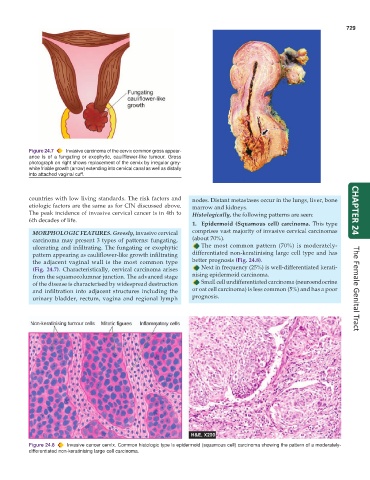
           Figure 24.7  Invasive carcinoma of the cervix common gross appear-
           ance is of a fungating or exophytic, cauliflower-like tumour. Gross
           photograph on right shows replacement of the cervix by irregular grey-
           white friable growth (arrow) extending into cervical canal as well as distally
           into attached vaginal cuff.


           countries with low living standards. The risk factors and  nodes. Distant metastases occur in the lungs, liver, bone
           etiologic factors are the same as for CIN discussed above.  marrow and kidneys.
           The peak incidence of invasive cervical cancer is in 4th to  Histologically, the following patterns are seen:  CHAPTER 24
           6th decades of life.
                                                                 1. Epidermoid (Squamous cell) carcinoma. This type
            MORPHOLOGIC FEATURES. Grossly, invasive cervical     comprises vast majority of invasive cervical carcinomas
            carcinoma may present 3 types of patterns: fungating,  (about 70%).
            ulcerating and infiltrating. The fungating or exophytic  The most common pattern (70%) is moderately-
            pattern appearing as cauliflower-like growth infiltrating  differentiated non-keratinising large cell type and has
            the adjacent vaginal wall is the most common type    better prognosis (Fig. 24.8).
            (Fig. 24.7). Characteristically, cervical carcinoma arises  Next in frequency (25%) is well-differentiated kerati-
            from the squamocolumnar junction. The advanced stage  nising epidermoid carcinoma.
            of the disease is characterised by widespread destruction  Small cell undifferentiated carcinoma (neuroendocrine
            and infiltration into adjacent structures including the  or oat cell carcinoma) is less common (5%) and has a poor  The Female Genital Tract
            urinary bladder, rectum, vagina and regional lymph   prognosis.


           Figure 24.8  Invasive cancer cervix. Common histologic type is epidermoid (squamous cell) carcinoma showing the pattern of a moderately-
           differentiated non-keratinising large cell carcinoma.

