


Page 742 - Textbook of Pathology, 6th Edition
P. 742
726
TABLE 24.3: Classification of Cervical Intraepithelial Neoplasia/Squamous Intraepithelial Lesion (CIN/SIL).
Bethesda System HPV Types Morphology CIN Dysplasia
L-SIL 6, 11 Koilocytic atypia, flat condyloma CIN-1 Mild
H-SIL 16, 18 Progressive cellular atypia, loss of maturation CIN-2, CIN-3 Moderate, severe,
carcinoma in situ
(L-SIL = Low-grade squamous intraepithelial lesions; H-SIL = High-grade squamous intraepithelial lesion; CIN= Cervical intraepithelial neoplasia)
SIL. Currently, the National Cancer Institute (NCI) of the women, cigarette smoking women, users of oral
US has proposed the Bethesda System (TBS) for reporting contraceptives, HIV infection and immunosuppression,
cervical and vaginal cytopathology. According to the while a low incidence is noted in virgins and nuns.
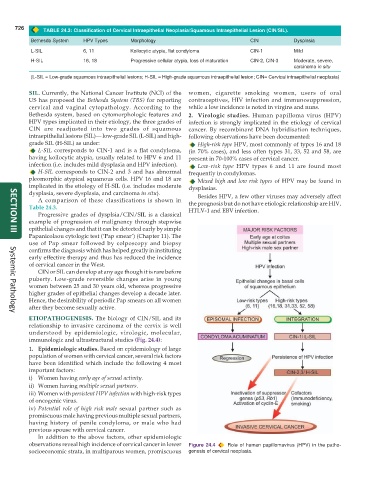
Bethesda system, based on cytomorphologic features and 2. Virologic studies. Human papilloma virus (HPV)
HPV types implicated in their etiology, the three grades of infection is strongly implicated in the etiology of cervical
CIN are readjusted into two grades of squamous cancer. By recombinant DNA hybridisation techniques,
intraepithelial lesions (SIL)— low-grade SIL (L-SIL) and high- following observations have been documented:
grade SIL (H-SIL) as under: High-risk type HPV, most commonly of types 16 and 18
L-SIL corresponds to CIN-1 and is a flat condyloma, (in 70% cases), and less often types 31, 33, 52 and 58, are
having koilocytic atypia, usually related to HPV 6 and 11 present in 70-100% cases of cervical cancer.
infection (i.e. includes mild dysplasia and HPV infection). Low-risk type HPV types 6 and 11 are found most
H-SIL corresponds to CIN-2 and 3 and has abnormal frequently in condylomas.
pleomorphic atypical squamous cells. HPV 16 and 18 are Mixed high and low risk types of HPV may be found in
implicated in the etiology of H-SIL (i.e. includes moderate dysplasias.
dysplasia, severe dysplasia, and carcinoma in situ). Besides HPV, a few other viruses may adversely affect
A comparison of these classifications is shown in the prognosis but do not have etiologic relationship are HIV,
Table 24.3. HTLV-1 and EBV infection.
Progressive grades of dysplsia/CIN/SIL is a classical
example of progression of malignancy through stepwise
epithelial changes and that it can be detected early by simple
Papanicolaou cytologic test (‘Pap smear’) (Chapter 11). The
SECTION III
use of Pap smear followed by colposcopy and biopsy
confirms the diagnosis which has helped greatly in instituting
early effective therapy and thus has reduced the incidence
of cervical cancer in the West.
CIN or SIL can develop at any age though it is rare before
puberty. Low-grade reversible changes arise in young
women between 25 and 30 years old, whereas progressive
higher grades of epithelial changes develop a decade later.
Hence, the desirability of periodic Pap smears on all women
after they become sexually active.
Systemic Pathology
ETIOPATHOGENESIS. The biology of CIN/SIL and its
relationship to invasive carcinoma of the cervix is well
understood by epidemiologic, virologic, molecular,
immunologic and ultrastructural studies (Fig. 24.4):
1. Epidemiologic studies. Based on epidemiology of large
population of women with cervical cancer, several risk factors
have been identified which include the following 4 most
important factors:
i) Women having early age of sexual activity.
ii) Women having multiple sexual partners.
iii) Women with persistent HPV infection with high-risk types
of oncogenic virus.
iv) Potential role of high risk male sexual partner such as
promiscuous male having previous multiple sexual partners,
having history of penile condyloma, or male who had
previous spouse with cervical cancer.
In addition to the above factors, other epidemiologic
observations reveal high incidence of cervical cancer in lower Figure 24.4 Role of human papillomavirus (HPV) in the patho-
socioeconomic strata, in multiparous women, promiscuous genesis of cervical neoplasia.

