


Page 741 - Textbook of Pathology, 6th Edition
P. 741
chronic cervicitis are the normal mixed vaginal flora that                                               725
           includes streptococci, enterococci (e.g.  E. coli)  and
           staphylococci. Other infecting organisms include gonococci,
           Trichomonas vaginalis, Candida albicans and herpes simplex.
           Factors predisposing to chronic cervicitis are sexual
           intercourse, trauma of childbirth, instrumentation and excess
           or deficiency of oestrogen.
            Grossly, there is eversion of ectocervix with hyperaemia,
            oedema and granular surface. Nabothian (retention) cysts
            may be grossly visible from the surface as pearly grey
            vesicles.
            Histologically, chronic cervicitis is characterised by
            extensive subepithelial inflammatory infiltrate of
            lymphocytes, plasma cells, large mononuclear cells and a
            few neutrophils. There may be formation of lymphoid
            follicles termed follicular cervicitis. The surface epithelium
            may be normal, or may show squamous metaplasia. The
            squamous epithelium of the ectocervix in cases of uterine
            prolapse may develop surface keratinisation and
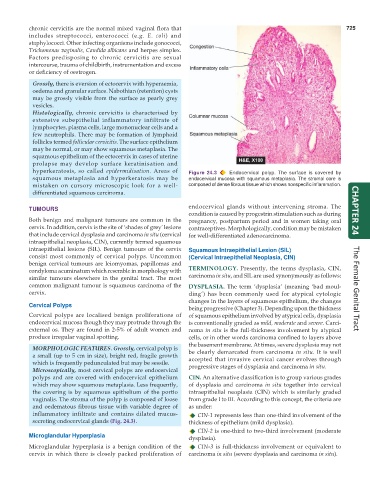
            hyperkeratosis, so called  epidermidisation.  Areas of  Figure 24.3  Endocervical polyp. The surface is covered by
            squamous metaplasia and hyperkeratosis may be      endocervical mucosa with squamous metaplasia. The stromal core is
            mistaken on cursory microscopic look for a well-   composed of dense fibrous tissue which shows nonspecific inflammation.
            differentiated squamous carcinoma.

           TUMOURS                                             endocervical glands without intervening stroma. The
                                                               condition is caused by progestrin stimulation such as during  CHAPTER 24
           Both benign and malignant tumours are common in the  pregnancy, postpartum period and in women taking oral
           cervix. In addition, cervix is the site of ‘shades of grey’ lesions  contraceptives. Morphologically, condition may be mistaken
           that include cervical dysplasia and carcinoma in situ (cervical  for well-differentiated adenocarcinoma.
           intraepithelial neoplasia, CIN), currently termed squamous
           intraepithelial lesions (SIL). Benign tumours of the cervix  Squamous Intraepithelial Lesion (SIL)
           consist most commonly of cervical polyps. Uncommon  (Cervical Intraepithelial Neoplasia, CIN)
           benign cervical tumours are leiomyomas, papillomas and
           condyloma acuminatum which resemble in morphology with  TERMINOLOGY.  Presently, the terms dysplasia, CIN,
           similar tumours elsewhere in the genital tract. The most  carcinoma in situ, and SIL are used synonymously as follows:
           common malignant tumour is squamous carcinoma of the  DYSPLASIA.  The term ‘dysplasia’ (meaning ‘bad moul-
           cervix.                                             ding’) has been commonly used for atypical cytologic   The Female Genital Tract
                                                               changes in the layers of squamous epithelium, the changes
           Cervical Polyps
                                                               being progressive (Chapter 3). Depending upon the thickness
           Cervical polyps are localised benign proliferations of  of squamous epithelium involved by atypical cells, dysplasia
           endocervical mucosa though they may protrude through the  is conventionally graded as mild, moderate and severe. Carci-
           external os. They are found in 2-5% of adult women and  noma in situ is the full-thickness involvement by atypical
           produce irregular vaginal spotting.                 cells, or in other words carcinoma confined to layers above
                                                               the basement membrane. At times, severe dysplasia may not
            MORPHOLOGIC FEATURES. Grossly, cervical polyp is   be clearly demarcated from carcinoma in situ. It is well
            a small (up to 5 cm in size), bright red, fragile growth  accepted that invasive cervical cancer evolves through
            which is frequently pedunculated but may be sessile.
            Microscopically, most cervical polyps are endocervical  progressive stages of dysplasia and carcinoma in situ.
            polyps and are covered with endocervical epithelium  CIN. An alternative classification is to group various grades
            which may show squamous metaplasia. Less frequently,  of dysplasia and carcinoma  in situ together into cervical
            the covering is by squamous epithelium of the portio  intraepithelial neoplasia (CIN) which is similarly graded
            vaginalis. The stroma of the polyp is composed of loose  from grade I to III. According to this concept, the criteria are
            and oedematous fibrous tissue with variable degree of  as under:
            inflammatory infiltrate and contains dilated mucus-   CIN-1 represents less than one-third involvement of the
            secreting endocervical glands (Fig. 24.3).         thickness of epithelium (mild dysplasia).
                                                                  CIN-2 is one-third to two-third involvement (moderate
           Microglandular Hyperplasia                          dysplasia).
           Microglandular hyperplasia is a benign condition of the  CIN-3 is full-thickness involvement or equivalent to
           cervix in which there is closely packed proliferation of  carcinoma in situ (severe dysplasia and carcinoma in situ).

