


Page 784 - Textbook of Pathology, 6th Edition
P. 784
768


            Chapter 26                                          The Skin
            Chapter 26


                       NORMAL STRUCTURE

           The skin or the integument is the external organ that protects
           against mechanical trauma, UV light and infection. In
           addition, the skin is concerned with thermoregulation,
           conservation and excretion of fluid, sensory perception and,
           of course, has aesthetic role for appearance of the indidivdual.
              The histology of normal skin shows some variation in
           different parts of the body. In general, it is composed of 2
           layers, the epidermis and the dermis, which are separated
           by an irregular border. Cone-shaped dermal papillae extend
           upward into the epidermis forming peg-like rete ridges of the
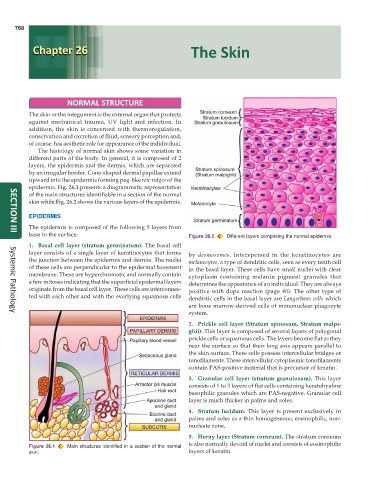
           epidermis. Fig. 26.1 presents a diagrammatic representation
           of the main structures identifiable in a section of the normal
           skin while Fig. 26.2 shows the various layers of the epidermis.

           EPIDERMIS
           The epidermis is composed of the following 5 layers from
           base to the surface:                                Figure 26.2  Different layers comprising the normal epidermis.
     SECTION III
           1. Basal cell layer (stratum germinatum). The basal cell
           layer consists of a single layer of keratinocytes that forms  by  desmosomes. Interspersed in the keratinocytes are
           the junction between the epidermis and dermis. The nuclei  melanocytes, a type of dendritic cells, seen as every tenth cell
           of these cells are perpendicular to the epidermal basement  in the basal layer. These cells have small nuclei with clear
           membrane. These are hyperchromatic and normally contain  cytoplasm containing melanin pigment granules that
           a few mitoses indicating that the superficial epidermal layers  determines the appearance of an individual. They are always
           originate from the basal cell layer. These cells are interconnec-  positive with dopa reaction (page 40). The other type of
           ted with each other and with the overlying squamous cells  dendritic cells in the basal layer are Langerhans cells which
                                                               are bone marrow-derived cells of mononuclear-phagocyte
                                                               system.
     Systemic Pathology
                                                               2. Prickle cell layer (Stratum spinosum, Stratum malpi-
                                                               ghii). This layer is composed of several layers of polygonal
                                                               prickle cells or squamous cells. The layers become flat as they
                                                               near the surface so that their long axis appears parallel to
                                                               the skin surface. These cells possess intercellular bridges or
                                                               tonofilaments. These intercellular cytoplasmic tonofilaments
                                                               contain PAS-positive material that is precursor of keratin.
                                                               3. Granular cell layer (stratum granulosum). This layer
                                                               consists of 1 to 3 layers of flat cells containing keratohyaline
                                                               basophilic granules which are PAS-negative. Granular cell
                                                               layer is much thicker in palms and soles.
                                                               4. Stratum lucidum.  This layer is present exclusively in
                                                               palms and soles as a thin homogeneous, eosinophilic, non-
                                                               nucleate zone.
                                                               5. Horny layer (Stratum corneum). The stratum corneum
                                                               is also normally devoid of nuclei and consists of eosinophilic
           Figure 26.1  Main structures identified in a section of the normal
           skin.                                               layers of keratin.

