


Page 788 - Textbook of Pathology, 6th Edition
P. 788
772 iii) Verruca planatairs or plantar warts occur on the sole of
TABLE 26.1: Correlation of HPV Types with Disease.
the foot and is caused by HPV-1. They are covered with a
Disease Common Malignant thick callus. They may, therefore, resemble calluses or a
Type Potential
verrucous carcinoma.
1. Common wart 1, 2 41 iv) Epidermodysplasia verruciformis resembles verruca
(verruca vulgaris) plana but differs by having familial occurrence with
2. Palmoplantar wart 1, 2 — autosomal recessive inheritance. The genome of HPV types
3. Flat wart (verruca plana) 3, 10 41 5 and 8 have been found in some of these tumours. Epidermo-
4. Anogenital warts 6, 11 30, 45 dysplasia verruciformis is of special clinical significance as
(condyloma acuminatum) it may undergo malignant change, usually into Bowen’s
5. Bowen's disease 16 31 disease, and occasionally into squamous cell carcinoma.
6. Bowenoid papulosis 16 39, 45 v) Condyloma acuminatum or venereal wart or anogeni-
7. Laryngeal papilloma 6, 11 — tal wart occurs on the penis, on the vulva and around the
8. Conjunctival papilloma 6, 11, 16 16 anus (page 714). They are commonly caused by HPV-6. The
9. Epidermodysplasia 2, 3, 9, 10 5, 8 lesions appear as soft, papillary, cauliflower-like mass that
verruciformis may grow fairly large in size (giant condyloma acuminata).
10. Cervical carcinoma 16, 18 16, 18, 31, 33 In rare cases, transformation into verrucous carcinoma may
occur.
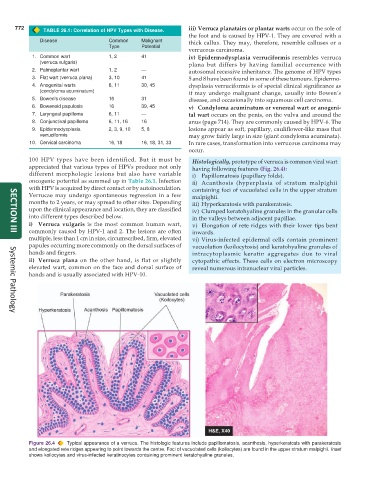
100 HPV types have been identified. But it must be Histologically, prototype of verruca is common viral wart
appreciated that various types of HPVs produce not only having following features (Fig. 26.4):
different morphologic lesions but also have variable i) Papillomatosis (papillary folds).
oncogenic potential as summed up in Table 26.1. Infection ii) Acanthosis (hyperplasia of stratum malpighii
with HPV is acquired by direct contact or by autoinoculation. containing foci of vacuolated cells in the upper stratum
Verrucae may undergo spontaneous regression in a few malpighii.
months to 2 years, or may spread to other sites. Depending iii) Hyperkaratosis with parakeratosis.
upon the clinical appearance and location, they are classified iv) Clumped keratohyaline granules in the granular cells
into different types described below. in the valleys between adjacent papillae.
i) Verruca vulgaris is the most common human wart, v) Elongation of rete ridges with their lower tips bent
commonly caused by HPV-1 and 2. The lesions are often inwards.
SECTION III
multiple, less than 1 cm in size, circumscribed, firm, elevated vi) Virus-infected epidermal cells contain prominent
papules occurring more commonly on the dorsal surfaces of vacuolation (koilocytosis) and keratohyaline granules of
hands and fingers. intracytoplasmic keratin aggregates due to viral
ii) Verruca plana on the other hand, is flat or slightly cytopathic effects. These cells on electron microscopy
elevated wart, common on the face and dorsal surface of reveal numerous intranuclear viral particles.
hands and is usually associated with HPV-10.
Systemic Pathology
Figure 26.4 Typical appearance of a verruca. The histologic features include papillomatosis, acanthosis, hyperkeratosis with parakeratosis
and elongated rete ridges appearing to point towards the centre. Foci of vacuolated cells (koilocytes) are found in the upper stratum malpighii. Inset
shows koilocytes and virus-infected keratinocytes containing prominent keratohyaline granules.

