


Page 789 - Textbook of Pathology, 6th Edition
P. 789
nerves and the tissues supplied by the nerves. The condition  773
                                                               is characterised by sharp burning pain, often dispropor-
                                                               tionate to the rash. Herpes simplex, caused by HSV-1, and
                                                               another related herpetic infection, herpes genitalis, caused
                                                               by HSV-2, are characterised by transmission by direct
                                                               physical contact and prolonged latency. The vesicular lesions
                                                               are often located on the skin, especially the facial skin around
                                                               lips and external nares; other sites are mucosal surfaces and
                                                               eyes.

                                                                 Histologically, the characteristic feature of viral exan-
                                                                 themata is the formation of intra-epidermal vesicles or
                                                                 bullae due to cytopathic effects of viruses. In the early
                                                                 stage, there is proliferation of epidermal cells and
                                                                 formation of multinucleate giant cells. This is followed
                                                                 by intracellular oedema and ballooning degeneration that
                                                                 progresses on to rupture of the cells with eventual
                                                                 formation of vesicles or bullae.
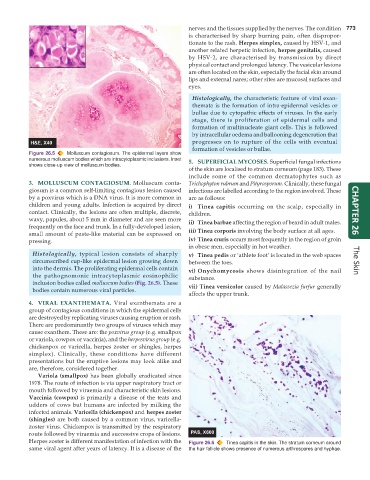
           Figure 26.5  Molluscum contagiosum. The epidermal layers show
           numerous molluscum bodies which are intracytoplasmic inclusions. Inset  5. SUPERFICIAL MYCOSES. Superficial fungal infections
           shows close-up view of molluscum bodies.
                                                               of the skin are localised to stratum corneum (page 183). These
                                                               include some of the common dermatophytes such as
           3. MOLLUSCUM CONTAGIOSUM. Molluscum conta-          Trichophyton rubrum and Pityrosporum. Clinically, these fungal
           giosum is a common self-limiting contagious lesion caused  infections are labelled according to the region involved. These
           by a poxvirus which is a DNA virus. It is more common in  are as follows:
           children and young adults. Infection is acquired by direct  i) Tinea capitis occurring on the scalp, especially in
           contact. Clinically, the lesions are often multiple, discrete,  children.                                  CHAPTER 26
           waxy, papules, about 5 mm in diameter and are seen more  ii) Tinea barbae affecting the region of beard in adult males.
           frequently on the face and trunk. In a fully-developed lesion,
           small amount of paste-like material can be expressed on  iii) Tinea corporis involving the body surface at all ages.
           pressing.                                           iv) Tinea cruris occurs most frequently in the region of groin
                                                               in obese men, especially in hot weather.
            Histologically, typical lesion consists of sharply  v) Tinea pedis or ‘athlete foot’ is located in the web spaces
            circumscribed cup-like epidermal lesion growing down  between the toes.                                   The Skin
            into the dermis. The proliferating epidermal cells contain  vi) Onychomycosis shows disintegration of the nail
            the pathognomonic intracytoplasmic eosinophilic    substance.
            inclusion bodies called molluscum bodies (Fig. 26.5). These  vii) Tinea versicolor caused by Malassezia furfur generally
            bodies contain numerous viral particles.
                                                               affects the upper trunk.
           4. VIRAL EXANTHEMATA.  Viral exanthemata are a
           group of contagious conditions in which the epidermal cells
           are destroyed by replicating viruses causing eruption or rash.
           There are predominantly two groups of viruses which may
           cause exanthem. These are: the poxvirus group (e.g. smallpox
           or variola, cowpox or vaccinia), and the herpesvirus group (e.g.
           chickenpox or varicella, herpes zoster or shingles, herpes
           simplex). Clinically, these conditions have different
           presentations but the eruptive lesions may look alike and
           are, therefore, considered together.
              Variola (smallpox) has been globally eradicated since
           1978. The route of infection is via upper respiratory tract or
           mouth followed by viraemia and characteristic skin lesions.
           Vaccinia (cowpox) is primarily a disease of the teats and
           udders of cows but humans are infected by milking the
           infected animals. Varicella (chickenpox) and herpes zoster
           (shingles) are both caused by a common virus, varicella-
           zoster virus. Chickenpox is transmitted by the respiratory
           route followed by viraemia and successive crops of lesions.
           Herpes zoster is different manifestation of infection with the  Figure 26.6  Tinea capitis in the skin. The stratum corneum around
           same viral agent after years of latency. It is a disease of the  the hair follicle shows presence of numerous arthrospores and hyphae.

