


Page 787 - Textbook of Pathology, 6th Edition
P. 787
Erythema nodosum, acute or chronic, is the most   771
                                                               common form. The lesions consist of tender red nodules, 1-5
                                                               cm in diameter, seen more often on the anterior surface of
                                                               the lower legs. Erythema nodosum is often found in
                                                               association with bacterial or fungal infections, drug intake,
                                                               inflammatory bowel disease and certain malignancies.
                                                                  Erythema induratum is a less common variety. The
                                                               lesions are chronic, painless, slightly tender, recurrent and
                                                               found on the calves of lower legs.
                                                                 Histologically, the early lesions show necrotising vascu-
                                                                 litis involving the blood vessels in the deep dermis and
                                                                 subcutis. In chronic stage, there is inflammatory infiltrate
                                                                 consisting of lymphocytes, histiocytes and multinucleate
                                                                 giant cells. The infiltrate is located in the septa separating
                                                                 the lobules of fat.

                                                               5. ACNE VULGARIS.  Acne vulgaris is a very common
                                                               chronic inflammatory dermatosis found predominantly in
                                                               adolescents in both sexes. The lesions are seen more
                                                               commonly on the face, upper chest and upper back. The
                                                               appearance of lesions around puberty is related to
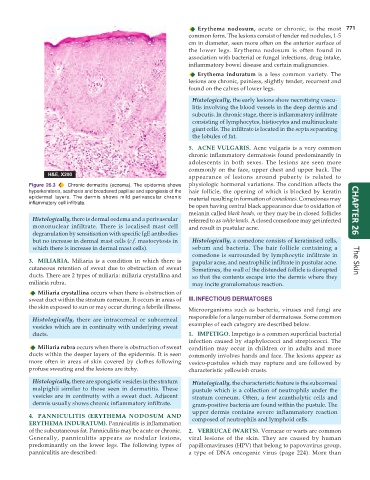
           Figure 26.3  Chronic dermatitis (eczema). The epidermis shows  physiologic hormonal variations. The condition affects the
           hyperkeratosis, acathosis and broadened papillae and spongiosis of the  hair follicle, the opening of which is blocked by keratin
           epidermal layers.  The dermis shows mild perivascular chronic  material resulting in formation of comedones. Comedones may
           inflammatory cell infiltrate.
                                                               be open having central black appearance due to oxidation of
                                                               melanin called black heads, or they may be in closed follicles  CHAPTER 26
            Histologically, there is dermal oedema and a perivascular  referred to as white heads. A closed comedone may get infected
            mononuclear infiltrate. There is localised mast cell  and result in pustular acne.
            degranulation by sensitisation with specific IgE antibodies
            but no increase in dermal mast cells (c.f. mastocytosis in  Histologically, a comedone consists of keratinised cells,
            which there is increase in dermal mast cells).       sebum and bacteria. The hair follicle containing a
                                                                 comedone is surrounded by lymphocytic infiltrate in
           3. MILIARIA.  Miliaria is a condition in which there is  papular acne, and neutrophilic infiltrate in pustular acne.  The Skin
           cutaneous retention of sweat due to obstruction of sweat  Sometimes, the wall of the distended follicle is disrupted
           ducts. There are 2 types of miliaria: miliaria crystallina and  so that the contents escape into the dermis where they
           miliaria rubra.                                       may incite granulomatous reaction.
              Miliaria crystallina occurs when there is obstruction of
           sweat duct within the stratum corneum. It occurs in areas of  III. INFECTIOUS DERMATOSES
           the skin exposed to sun or may occur during a febrile illness.  Microorganisms such as bacteria, viruses and fungi are
            Histologically, there are intracorneal or subcorneal  responsible for a large number of dermatoses. Some common
            vesicles which are in continuity with underlying sweat  examples of each category are described below.
            ducts.                                             1. IMPETIGO. Impetigo is a common superficial bacterial
                                                               infection caused by staphylococci and streptococci. The
              Miliaria rubra occurs when there is obstruction of sweat  condition may occur in children or in adults and more
           ducts within the deeper layers of the epidermis. It is seen  commonly involves hands and face. The lesions appear as
           more often in areas of skin covered by clothes following  vesico-pustules which may rupture and are followed by
           profuse sweating and the lesions are itchy.         characteristic yellowish crusts.

            Histologically, there are spongiotic vesicles in the stratum  Histologically, the characteristic feature is the subcorneal
            malpighii similar to those seen in dermatitis. These  pustule which is a collection of neutrophils under the
            vesicles are in continuity with a sweat duct. Adjacent  stratum corneum. Often, a few acantholytic cells and
            dermis usually shows chronic inflammatory infiltrate.  gram-positive bacteria are found within the pustule. The
                                                                 upper dermis contains severe inflammatory reaction
           4. PANNICULITIS (ERYTHEMA NODOSUM AND                 composed of neutrophils and lymphoid cells.
           ERYTHEMA INDURATUM). Panniculitis is inflammation
           of the subcutaneous fat. Panniculitis may be acute or chronic.  2. VERRUCAE (WARTS). Verrucae or warts are common
           Generally, panniculitis appears as nodular lesions,  viral lesions of the skin. They are caused by human
           predominantly on the lower legs. The following types of  papillomaviruses (HPV) that belong to papovavirus group,
           panniculitis are described:                         a type of DNA oncogenic virus (page 224). More than

