


Page 790 - Textbook of Pathology, 6th Edition
P. 790
774   Histologically, fungal hyphae (or mycelia) and
            arthrospores of dermatophytes are present in the stratum
            corneum of skin, nails or hair. Hyphae may be septate or
            nonseptate. Spores are round to oval bodies which grow
            by budding. Special stains can be used to demonstrate
            the fungi. These are:  periodic acid-Schiff (PAS) reaction
            which stains the fungi deep pink to red (Fig. 26.6), and
            methenamine silver nitrate method that stains fungi black.

           IV.GRANULOMATOUS DISEASES
           In many skin diseases, the host may respond by granu-
           lomatous inflammation to a variety of microbial agents and
           nonmicrobial material. Tuberculosis of the skin is the classical
           example in which typical tubercles are formed; other
           conditions are leprosy, syphilis, sarcoidosis, deep fungal
           infection etc. These conditions have already been discussed
           in Chapter 6. Nonmicrobial agents which can incite
           granulomatous inflammation are keratin, hair, thorns, talc,
           minerals like beryllium, asbestos and tattoo pigment etc.
              Important representative examples of granulomatous
           inflammation—lupus vulgaris,  cutaneous sarcoidosis and
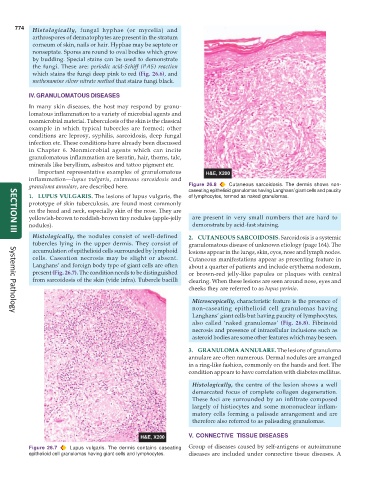
           granuloma annulare, are described here.             Figure 26.8   Cutaneous sarcoidosis. The dermis shows non-
                                                               caseating epithelioid granulomas having Langhans’ giant cells and paucity
           1. LUPUS VULGARIS. The lesions of lupus vulgaris, the  of lymphocytes, termed as naked granulomas.
           prototype of skin tuberculosis, are found most commonly
           on the head and neck, especially skin of the nose. They are
           yellowish-brown to reddish-brown tiny nodules (apple-jelly  are present in very small numbers that are hard to
           nodules).                                             demonstrate by acid-fast staining.
            Histologically, the nodules consist of well-defined  2. CUTANEOUS SARCOIDOSIS. Sarcoidosis is a systemic
     SECTION III
            tubercles lying in the upper dermis. They consist of  granulomatous disease of unknown etiology (page 164). The
            accumulation of epithelioid cells surrounded by lymphoid  lesions appear in the lungs, skin, eyes, nose and lymph nodes.
            cells. Caseation necrosis may be slight or absent.  Cutaneous manifestations appear as presenting feature in
            Langhans’ and foreign body type of giant cells are often  about a quarter of patients and include erythema nodosum,
            present (Fig. 26.7). The condition needs to be distinguished  or brown-red jelly-like papules or plaques with central
            from sarcoidosis of the skin (vide infra). Tubercle bacilli  clearing. When these lesions are seen around nose, eyes and
                                                               cheeks they are referred to as lupus perinio.
                                                                 Microscopically, characteristic feature is the presence of
                                                                 non-caseating epithelioid cell granulomas having
                                                                 Langhans’ giant cells but having paucity of lymphocytes,
     Systemic Pathology
                                                                 also called ‘naked granulomas’  (Fig. 26.8). Fibrinoid
                                                                 necrosis and presence of intracellular inclusions such as
                                                                 asteroid bodies are some other features which may be seen.

                                                               3. GRANULOMA ANNULARE. The lesions of granuloma
                                                               annulare are often numerous. Dermal nodules are arranged
                                                               in a ring-like fashion, commonly on the hands and feet. The
                                                               condition appears to have correlation with diabetes mellitus.

                                                                 Histologically, the centre of the lesion shows a well
                                                                 demarcated focus of complete collagen degeneration.
                                                                 These foci are surrounded by an infiltrate composed
                                                                 largely of histiocytes and some mononuclear inflam-
                                                                 matory cells forming a palisade arrangement and are
                                                                 therefore also referred to as palisading granulomas.

                                                               V. CONNECTIVE  TISSUE DISEASES

           Figure 26.7  Lupus vulgaris. The dermis contains caseating  Group of diseases caused by self-antigens or autoimmune
           epithelioid cell granulomas having giant cells and lymphocytes.  diseases are included under connective tissue diseases. A

