


Page 791 - Textbook of Pathology, 6th Edition
P. 791
list of such diseases along with their etiology and patho-  Direct immunofluorescence reveals granular deposits of  775
           genesis is given in Chapter 4. Morphology of skin lesions of  immunoglobulins, most commonly IgG and IgM, and
           two important representative examples—lupus erythematosus  components of complement on the basement membrane of
           and systemic sclerosis (scleroderma), is given below. Another  the affected skin in both DLE and SLE. High serum titres of
           connective tissue disease of unknown etiology, lichen  antinuclear antibodies and demonstration of LE cells (page
           sclerosus et atrophicus, is also considered here.   79) are other notable features, especially in SLE.
           1. LUPUS ERYTHEMATOSUS.  Two types of lupus         2. SYSTEMIC SCLEROSIS (SCLERODERMA).  Two
           erythematosus are recognised—a chronic form, discoid lupus  types of systemic sclerosis or scleroderma are identified: a
           erythematosus (DLE) which is confined to the skin; and a  localised form called morphea, and a generalised form called
           systemic form, systemic lupus erythematosus (SLE) that has  progressive systemic sclerosis. A variant of progressive
           widespread visceral vascular lesions. The discoid variety is  systemic sclerosis is  CREST syndrome.  (C = calcinosis,
           more common which is generally benign, while systemic  R = Raynaud’s phenomenon, E = esophageal dismotility,
           form may be fatal, usually from renal involvement. The  S = sclerodactyly and T = telangiectasia). Etiology and
           diagnosis is made on the basis of clinical, serologic and  pathogenesis of these conditions are already described
           pathologic changes. The characteristic cutaneous lesions in  (page 80). Morphea consists of lesions limited to the skin
           DLE consist of well-defined erythematous discoid patches  and subcutaneous tissue, while progressive systemic
           associated with scaling and atrophy and often limited to the  sclerosis consists of extensive involvement of the skin and
           face. In contrast, cutaneous lesions in SLE are present only  the subcutaneous tissue and has visceral lesions too. The
           in a small proportion of cases and consist of erythematous,  lesions generally begin in the fingers and distal extremities
           slightly oedematous patches which are without significant  and then extend proximally to involve the arms, shoulders,
           scaling and without atrophy.                        neck and face.
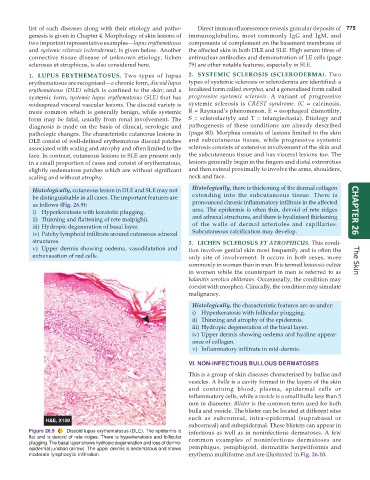
            Histologically, cutaneous lesion in DLE and SLE may not  Histologically, there is thickening of the dermal collagen
            be distinguishable in all cases. The important features are  extending into the subcutaneous tissue. There is
            as follows (Fig. 26.9):                              pronounced chronic inflammatory infiltrate in the affected
            i) Hyperkeratosis with keratotic plugging.           area. The epidermis is often thin, devoid of rete ridges  CHAPTER 26
            ii) Thinning and flattening of rete malpighii.       and adnexal structures, and there is hyalinised thickening
            iii) Hydropic degeneration of basal layer.           of the walls of dermal arterioles and capillaries.
            iv) Patchy lymphoid infiltrate around cutaneous adnexal  Subcutaneous calcification may develop.
            structures.                                        3. LICHEN SCLEROSUS ET ATROPHICUS. This condi-
            v) Upper dermis showing oedema, vasodilatation and  tion involves genital skin most frequently and is often the
            extravasation of red cells.                        only site of involvement. It occurs in both sexes, more
                                                               commonly in women than in men. It is termed kraurosis vulvae  The Skin
                                                               in women while the counterpart in men is referred to as
                                                               balanitis xerotica obliterans. Occasionally, the condition may
                                                               coexist with morphea. Clinically, the condition may simulate
                                                               malignancy.
                                                                 Histologically, the characteristic features are as under:
                                                                 i) Hyperkeratosis with follicular plugging.
                                                                 ii) Thinning and atrophy of the epidermis.
                                                                 iii) Hydropic degeneration of the basal layer.
                                                                 iv) Upper dermis showing oedema and hyaline appear-
                                                                 ance of collagen.
                                                                 v) Inflammatory infiltrate in mid-dermis.

                                                               VI. NON-INFECTIOUS BULLOUS DERMATOSES
                                                               This is a group of skin diseases characterised by bullae and
                                                               vesicles. A bulla is a cavity formed in the layers of the skin
                                                               and containing blood, plasma, epidermal cells or
                                                               inflammatory cells, while a vesicle is a small bulla less than 5
                                                               mm in diameter. Blister is the common term used for both
                                                               bulla and vesicle. The blister can be located at different sites
                                                               such as subcorneal, intra-epidermal (suprabasal or
                                                               subcorneal) and subepidermal. These blisters can appear in
           Figure 26.9  Discoid lupus erythematosus (DLE). The epidermis is  infectious as well as in noninfectious dermatoses. A few
           flat and is devoid of rete ridges. There is hyperkeratosis and follicular  common examples of noninfectious dermatoses are
           plugging. The basal layer shows hydropic degeneration and loss of dermo-
           epidermal junction (arrow). The upper dermis is oedematous and shows  pemphigus, pemphigoid, dermatitis herpetiformis and
           moderate lymphocytic infiltration.                  erythema multiforme and are illustrated in Fig. 26.10.

