


Page 793 - Textbook of Pathology, 6th Edition
P. 793
epidermal regeneration from the periphery at the floor of  777
                                                                 the bulla. The bullous cavity contains fibrin network and
                                                                 many mononuclear inflammatory cells and many
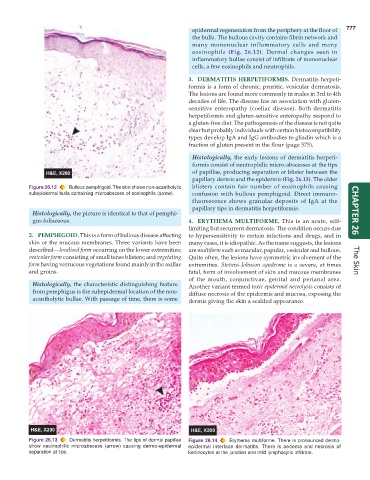
                                                                 eosinophils  (Fig. 26.12). Dermal changes seen in
                                                                 inflammatory bullae consist of infiltrate of mononuclear
                                                                 cells, a few eosinophils and neutrophils.

                                                               3. DERMATITIS HERPETIFORMIS. Dermatitis herpeti-
                                                               formis is a form of chronic, pruritic, vesicular dermatosis.
                                                               The lesions are found more commonly in males in 3rd to 4th
                                                               decades of life. The disease has an association with gluten-
                                                               sensitive enteropathy (coeliac disease). Both dermatitis
                                                               herpetiformis and gluten-sensitive enteropathy respond to
                                                               a gluten-free diet. The pathogenesis of the disease is not quite
                                                               clear but probably individuals with certain histocompatibility
                                                               types develop IgA and IgG antibodies to gliadin which is a
                                                               fraction of gluten present in the flour (page 575).

                                                                 Histologically, the early lesions of dermatitis herpeti-
                                                                 formis consist of neutrophilic micro-abscesses at the tips
                                                                 of papillae, producing separation or blister between the
                                                                 papillary dermis and the epidermis (Fig. 26.13). The older
           Figure 26.12  Bullous pemphigoid. The skin shows non-acantholytic  blisters contain fair number of eosinophils causing
           subepidermal bulla containing microabscess of eosinophils (arrow).  confusion with bullous pemphigoid. Direct immuno-
                                                                 fluorescence shows granular deposits of IgA at the
                                                                 papillary tips in dermatitis herpetiformis.
            Histologically, the picture is identical to that of pemphi-                                               CHAPTER 26
            gus foliaceous.                                    4. ERYTHEMA MULTIFORME.  This is an acute, self-
                                                               limiting but recurrent dermatosis. The condition occurs due
           2. PEMPHIGOID. This is a form of bullous disease affecting  to hypersensitivity to certain infections and drugs, and in
           skin or the mucous membranes. Three variants have been  many cases, it is idiopathic. As the name suggests, the lesions
           described—localised form occurring on the lower extremities;  are multiform such as macular, papular, vesicular and bullous.
           vesicular form consisting of small tense blisters; and vegetating  Quite often, the lesions have symmetric involvement of the
           form having verrucous vegetations found mainly in the axillae  extremities.  Stevens-Johnson syndrome is a severe, at times  The Skin
           and groins.                                         fatal, form of involvement of skin and mucous membranes
                                                               of the mouth, conjunctivae, genital and perianal area.
            Histologically, the characteristic distinguishing feature  Another variant termed toxic epidermal necrolysis consists of
            from pemphigus is the subepidermal location of the non-  diffuse necrosis of the epidermis and mucosa, exposing the
            acantholytic bullae. With passage of time, there is some  dermis giving the skin a scalded appearance.


           Figure 26.13  Dermatitis herpetiformis. The tips of dermal papillae  Figure 26.14  Erythema multiforme. There is pronounced dermo-
           show neutrophilic microabscess (arrow) causing dermo-epidermal  epidermal interface dermatitis. There is oedema and necrosis of
           separation at tips.                                 kertinocytes at the junction and mild lymphocytic infiltrate.

