


Page 794 - Textbook of Pathology, 6th Edition
P. 794
778


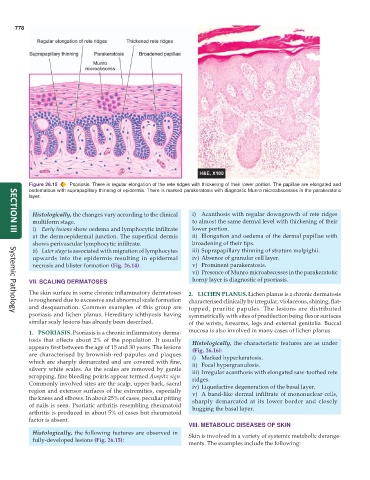
           Figure 26.15  Psoriasis. There is regular elongation of the rete ridges with thickening of their lower portion. The papillae are elongated and
           oedematous with suprapapillary thinning of epidermis. There is marked parakeratosis with diagnostic Munro microabscesses in the parakeratotic
           layer.


            Histologically, the changes vary according to the clinical  i) Acanthosis with regular downgrowth of rete ridges
            multiform stage.                                     to almost the same dermal level with thickening of their
            i) Early lesions show oedema and lymphocytic infiltrate  lower portion.
            at the dermoepidermal junction. The superfical dermis  ii) Elongation and oedema of the dermal papillae with
     SECTION III
            shows perivascular lymphocytic infiltrate.           broadening of their tips.
            ii) Later stage is associated with migration of lymphocytes  iii) Suprapapillary thinning of stratum malpighii.
            upwards into the epidermis resulting in epidermal    iv) Absence of granular cell layer.
            necrosis and blister formation (Fig. 26.14).         v) Prominent parakeratosis.
                                                                 vi) Presence of Munro microabscesses in the parakeratotic
           VII. SCALING DERMATOSES                               horny layer is diagnostic of psoriasis.

           The skin surface in some chronic inflammatory dermatoses  2. LICHEN PLANUS. Lichen planus is a chronic dermatosis
           is roughened due to excessive and abnormal scale formation  characterised clinically by irregular, violaceous, shining, flat-
           and desquamation. Common examples of this group are  topped, pruritic papules. The lesions are distributed
           psoriasis and lichen planus. Hereditary ichthyosis having  symmetrically with sites of predilection being flexor surfaces
     Systemic Pathology
           similar scaly lesions has already been described.   of the wrists, forearms, legs and external genitalia. Buccal
           1. PSORIASIS. Psoriasis is a chronic inflammatory derma-  mucosa is also involved in many cases of lichen planus.
           tosis that affects about 2% of the population. It usually  Histologically, the characteristic features are as under
           appears first between the age of 15 and 30 years. The lesions  (Fig. 26.16):
           are characterised by brownish-red papules and plaques  i) Marked hyperkeratosis.
           which are sharply demarcated and are covered with fine,  ii) Focal hypergranulosis.
           silvery white scales. As the scales are removed by gentle  iii) Irregular acanthosis with elongated saw-toothed rete
           scrapping, fine bleeding points appear termed Auspitz sign.  ridges.
           Commonly involved sites are the scalp, upper back, sacral  iv) Liquefactive degeneration of the basal layer.
           region and extensor surfaces of the extremities, especially  v) A band-like dermal infiltrate of mononuclear cells,
           the knees and elbows. In about 25% of cases, peculiar pitting  sharply demarcated at its lower border and closely
           of nails is seen. Psoriatic arthritis resembling rheumatoid  hugging the basal layer.
           arthritis is produced in about 5% of cases but rheumatoid
           factor is absent.
                                                               VIII. METABOLIC DISEASES OF SKIN
            Histologically, the following features are observed in  Skin is involved in a variety of systemic metabolic derange-
            fully-developed lesions (Fig. 26.15):
                                                               ments. The examples include the following:

