


Page 795 - Textbook of Pathology, 6th Edition
P. 795
779


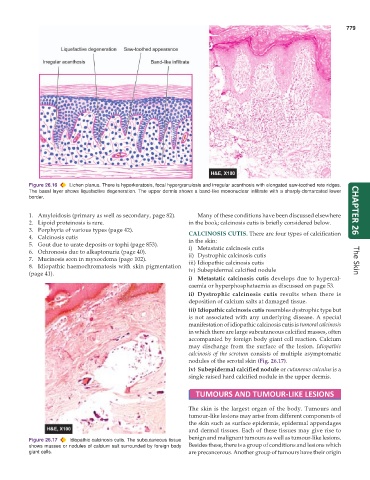
           Figure 26.16  Lichen planus. There is hyperkeratosis, focal hypergranulosis and irregular acanthosis with elongated saw-toothed rete ridges.
           The basal layer shows liquefactive degeneration. The upper dermis shows a band-like mononuclear infiltrate with a sharply-demarcated lower
           border.


           1. Amyloidosis (primary as well as secondary, page 82).  Many of these conditions have been discussed elsewhere  CHAPTER 26
           2. Lipoid proteinosis is rare.                      in the book; calcinosis cutis is briefly considered below.
           3. Porphyria of various types (page 42).            CALCINOSIS CUTIS. There are four types of calcification
           4. Calcinosis cutis                                 in the skin:
           5. Gout due to urate deposits or tophi (page 853).  i) Metastatic calcinosis cutis
           6. Ochronosis due to alkaptonuria (page 40).        ii) Dystrophic calcinosis cutis
           7. Mucinosis seen in myxoedema (page 102).          iii) Idiopathic calcinosis cutis                       The Skin
           8. Idiopathic haemochromatosis with skin pigmentation  iv) Subepidermal calcified nodule
           (page 41).
                                                               i) Metastatic calcinosis cutis develops due to hypercal-
                                                               caemia or hyperphosphataemia as discussed on page 53.
                                                               ii) Dystrophic calcinosis cutis results when there is
                                                               deposition of calcium salts at damaged tissue.
                                                               iii) Idiopathic calcinosis cutis resembles dystrophic type but
                                                               is not associated with any underlying disease. A special
                                                               manifestation of idiopathic calcinosis cutis is tumoral calcinosis
                                                               in which there are large subcutaneous calcified masses, often
                                                               accompanied by foreign body giant cell reaction. Calcium
                                                               may discharge from the surface of the lesion.  Idiopathic
                                                               calcinosis of the scrotum consists of multiple asymptomatic
                                                               nodules of the scrotal skin (Fig. 26.17).
                                                               iv) Subepidermal calcified nodule or cutaneous calculus is a
                                                               single raised hard calcified nodule in the upper dermis.

                                                                  TUMOURS AND TUMOUR-LIKE LESIONS


                                                               The skin is the largest organ of the body. Tumours and
                                                               tumour-like lesions may arise from different components of
                                                               the skin such as surface epidermis, epidermal appendages
                                                               and dermal tissues. Each of these tissues may give rise to
                                                               benign and malignant tumours as well as tumour-like lesions.
           Figure 26.17  Idiopathic calcinosis cutis. The subcutaneous tissue
           shows masses or nodules of calcium salt surrounded by foreign body  Besides these, there is a group of conditions and lesions which
           giant cells.                                        are precancerous. Another group of tumours have their origin

