


Page 798 - Textbook of Pathology, 6th Edition
P. 798
782                                                      in sun-exposed areas of the skin in fair-skinned elderly
                                                               people. Similar lesions may be induced by exposure to
                                                               ionising radiation, hydrocarbons and arsenicals. The
                                                               condition is considered to be a forerunner of invasive
                                                               squamous cell and/or basal cell carcinoma. Clinically, the
                                                               lesions are tan-brown, erythematous, about 1 cm in diameter
                                                               with rough, sandpaper-like surface and are seen more
                                                               commonly on the dorsum of the hands and on the balded
                                                               portion of the skin.
                                                                 Histologically, solar keratoses are squamous cell
                                                                 carcinoma in situ with the following characteristic features:
                                                                 i) Considerable hyperkeratosis.
                                                                 ii) Marked acanthosis.
                                                                 iii) Dyskeratosis and dysplasia of the epidermal cells
                                                                 showing features such as hyperchromatism, loss of
                                                                 polarity, pleomorphism and increased number of mitotic
                                                                 figures.
                                                                 iv) Non-specific chronic inflammatory cell infiltrate in the
                                                                 upper dermis encroaching upon the basement membrane
                                                                 of the epidermis.
                                                               2. BOWEN’S DISEASE.  Bowen’s disease is also a
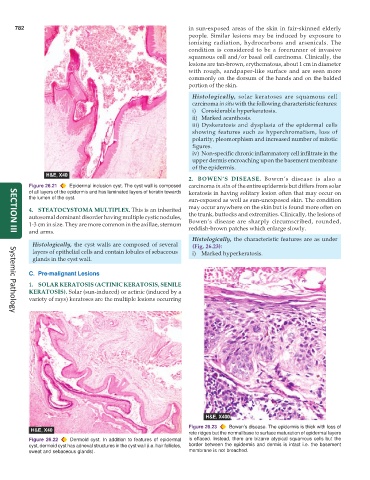
           Figure 26.21  Epidermal inclusion cyst. The cyst wall is composed  carcinoma in situ of the entire epidermis but differs from solar
           of all layers of the epidermis and has laminated layers of keratin towards  keratosis in having solitary lesion often that may occur on
           the lumen of the cyst.                              sun-exposed as well as sun-unexposed skin. The condition
           4. STEATOCYSTOMA MULTIPLEX. This is an inherited    may occur anywhere on the skin but is found more often on
           autosomal dominant disorder having multiple cystic nodules,  the trunk, buttocks and extremities. Clinically, the lesions of
           1-3 cm in size. They are more common in the axillae, sternum  Bowen’s disease are sharply circumscribed, rounded,
           and arms.                                           reddish-brown patches which enlarge slowly.
     SECTION III
                                                                 Histologically, the characteristic features are as under
            Histologically, the cyst walls are composed of several  (Fig. 26.23):
            layers of epithelial cells and contain lobules of sebaceous  i) Marked hyperkeratosis.
            glands in the cyst wall.

           C. Pre-malignant Lesions
           1. SOLAR KERATOSIS (ACTINIC KERATOSIS, SENILE
           KERATOSIS). Solar (sun-induced) or actinic (induced by a
           variety of rays) keratoses are the multiple lesions occurring

     Systemic Pathology


                                                               Figure 26.23  Bowen’s disease. The epidermis is thick with loss of
                                                               rete ridges but the normal base to surface maturation of epidermal layers
           Figure 26.22  Dermoid cyst. In addition to features of epidermal  is effaced. Instead, there are bizarre atypical squamous cells but the
           cyst, dermoid cyst has adnexal structures in the cyst wall (i.e. hair follicles,  border between the epidermis and dermis is intact i.e. the basement
           sweat and sebaceous glands).                        membrane is not breached.

