


Page 799 - Textbook of Pathology, 6th Edition
P. 799
ii) Pronounced parakeratosis.                         Cancer of scrotal skin in chimney-sweeps was the first  783
            iii) Marked epidermal hyperplasia with disappearance of  cancer in which an occupational carcinogen (soot) was impli-
            dermal papillae.                                   cated. ‘Kangari cancer’ of the skin of inner side of thigh and
            iv) Scattered bizarre dyskeratotic cells distributed  lower abdomen common in natives of Kashmir is another
            throughout the epidermis.                          example of skin cancer due to chronic irritation (Kangari is
                                                               an earthenware pot containing glowing charcoal used by
              Bowen’s disease, unlike solar keratosis which invariably  Kashmiris close to their abdomen to keep them warm).
           leads to invasive cancer, may remain confined to the surface  Although squamous carcinomas can occur anywhere on
           for many years.                                     the skin, most common locations are the face, pinna of the
           3. XERODERMA PIGMENTOSUM. This condition is a       ears, back of hands and mucocutaneous junctions such as
           hypersensitivity of the skin to sunlight that is determined  on the lips, anal canal and glans penis. Cutaneous squamous
           by a recessive gene. The disorder may lead to multiple  carcinoma arising in a pre-existing inflammatory and
           malignancies of the skin such as basal cell carcinoma,  degenerative lesion has a higher incidence of developing
           squamous cell carcinoma and malignant melanoma.     metastases.
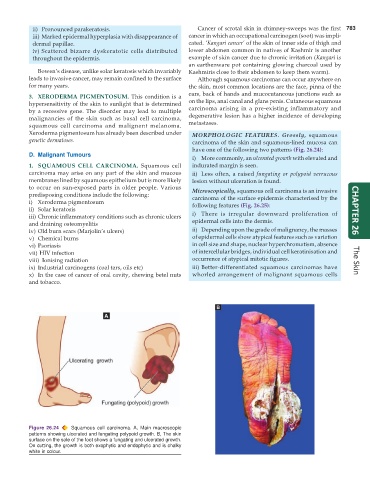
           Xeroderma pigmentosum has already been described under  MORPHOLOGIC FEATURES. Grossly, squamous
           genetic dermatoses.                                   carcinoma of the skin and squamous-lined mucosa can
                                                                 have one of the following two patterns (Fig. 26.24):
           D. Malignant Tumours
                                                                 i) More commonly, an ulcerated growth with elevated and
           1. SQUAMOUS CELL CARCINOMA. Squamous cell             indurated margin is seen.
           carcinoma may arise on any part of the skin and mucous  ii) Less often, a raised  fungating or polypoid verrucous
           membranes lined by squamous epithelium but is more likely  lesion without ulceration is found.
           to occur on sun-exposed parts in older people. Various  Microscopically, squamous cell carcinoma is an invasive
           predisposing conditions include the following:        carcinoma of the surface epidermis characterised by the
           i) Xeroderma pigmentosum                              following features (Fig. 26.25):
           ii) Solar keratosis                                                                                        CHAPTER 26
           iii) Chronic inflammatory conditions such as chronic ulcers  i) There is irregular downward proliferation of
           and draining osteomyelitis                            epidermal cells into the dermis.
           iv) Old burn scars (Marjolin’s ulcers)                ii) Depending upon the grade of malignancy, the masses
           v) Chemical burns                                     of epidermal cells show atypical features such as variation
           vi) Psoriasis                                         in cell size and shape, nuclear hyperchromatism, absence
           vii) HIV infection                                    of intercellular bridges, individual cell keratinisation and
           viii) Ionising radiation                              occurrence of atypical mitotic figures.              The Skin
           ix) Industrial carcinogens (coal tars, oils etc)      iii) Better-differentiated squamous carcinomas have
           x) In the case of cancer of oral cavity, chewing betel nuts  whorled arrangement of malignant squamous cells
           and tobacco.


           Figure 26.24  Squamous cell carcinoma. A, Main macroscopic
           patterns showing ulcerated and fungating polypoid growth. B, The skin
           surface on the sole of the foot shows a fungating and ulcerated growth.
           On cutting, the growth is both exophytic and endophytic and is chalky
           white in colour.

