


Page 828 - Textbook of Pathology, 6th Edition
P. 828
812 ETIOPATHOGENESIS.  Most important risk factor        translocation between 2 genes—PAX-8 (paired domain
           implicated in the etiology of thyroid cancer is external  transcription factor) and  PPARγ-1  (gene coding for
           radiation, and to a some extent there is role of TSH receptors  peroxisome proliferator-activator receptor γ-1), has also been
           and iodine excess, while pathogenesis of thyroid cancer is  described in a proportion of cases of follicular thyroid
           explained on genetic alterations.                   neoplasms, both adenoma and carcinoma.
           1. External radiation. The single most important    iii) Medullary thyroid carcinoma: Medullary thyroid carcinoma
           environmental factor associated with increased risk of  arises from parafollicular C-cells in the thyroid. Point
           developing thyroid carcinoma after many years of exposure  mutation in RET-protooncogene  is seen in both familial as a
           to external radiation of high dose. Evidences in support  well as sporadiac cases of medullary thyroid carcinoma.
           include: high incidence of thyroid cancer in individuals  iv) Anaplastic thyroid carcinoma: This tumour either arises from
           irradiated in early age for enlarged thymus and for skin  further dedifferentiation of differentiated papillary or
           disorders, in Japanese atomic bomb survivors, and in  follicular thyroid carcinoma, or by inactivating point
           individuals living in the vicinity of nuclear accident sites. In  mutation in p53 tumour suppressor gene or by mutation in
           particular, exposure to radiation to children and young adults  gene coding for β-catenin pathway.
           has been found to be associated with higher incidence of  Papillary Thyroid Carcinoma
           development of papillary carcinoma later.
           2. Iodine excess and TSH. In regions where endemic goitre  Papillary carcinoma is the most common type of thyroid
                                                               carcinoma, comprising 75-85% of cases. It can occur at all
           is widespread, addition of iodine to diet has resulted in  ages including children and young adults but the incidence
           increase in incidence of papillary cancer. Many well-  is higher with advancing age. The tumour is found about
           differentiated thyroid cancers express TSH receptors and thus  three times more frequently in females than in males.
           respond to T  suppression of TSH.                      Papillary carcinoma is typically a slow-growing
                     4
           3. Genetic basis. Familial clustering of thyroid cancer has  malignant tumour, most often presenting as an asymptomatic
           been observed, especially in medullary carcinoma. Molecular  solitary nodule. Involvement of the regional lymph nodes is
           studies reveal that thyroid carcinoma is a multistep process  common but distant metastases to organs are rare. Some cases
           involving genetic alterations but distinct mutations are seen  first come to attention by spread to regional lymph nodes
           in different histologic types:                      and cause cervical lymphadenopathy. ‘Lateral aberrant thyroid’
           i) Papillary thyroid carcinoma:  Mutation in RET gene (gene  is the term used for occurrence of thyroid tissue in the lateral
           overexpression) located on chromosome 10q is seen in about  cervical lymph node, which in most patients represents a
           20% cases of papillary thyroid carcinoma. This mutation  well-differentiated metastasis of an occult papillary
     SECTION III
           renders the tyrosine kinase receptor under the target of other  carcinoma of the thyroid.
           tumour-promoting factors such as radiation exposure in  MORPHOLOGIC FEATURES. Grossly, papillary carci-
           papillary carcinoma. Another genetic abnormality seen in  noma may range from microscopic foci to nodules upto
           5-10% cases of papillary thyroid carcinoma is gene    10 cm in diameter and is generally poorly delineated. Cut
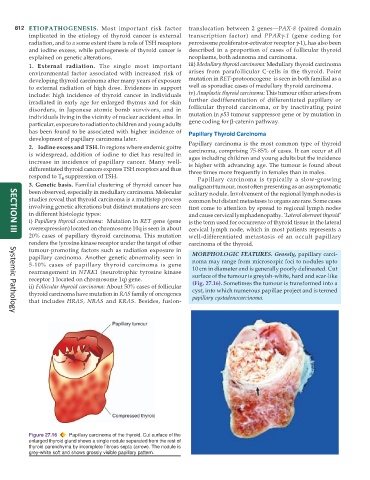
           rearrangement in  NTRK1 (neurotrophic tyrosine kinase  surface of the tumour is greyish-white, hard and scar-like
           receptor 1 located on chromosome 1q) gene.            (Fig. 27.16). Sometimes the tumour is transformed into a
           ii) Follicular thyroid carcinoma: About 50% cases of follicular  cyst, into which numerous papillae project and is termed
           thyroid carcinoma have mutation in RAS family of oncogenes
           that includes  HRAS,  NRAS and  KRAS. Besides, fusion-  papillary cystadenocarcinoma.

     Systemic Pathology


           Figure 27.16  Papillary carcinoma of the thyroid. Cut surface of the
           enlarged thyroid gland shows a single nodule separated from the rest of
           thyroid parenchyma by incomplete fibrous septa (arrow). The nodule is
           grey-white soft and shows grossly visible papillary pattern.

