


Page 835 - Textbook of Pathology, 6th Edition
P. 835
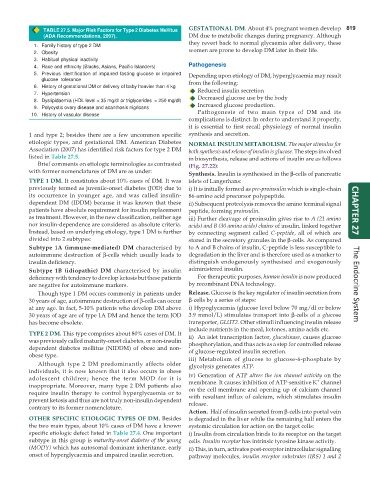
TABLE 27.5. Major Risk Factors for Type 2 Diabetes Mellitus GESTATIONAL DM. About 4% pregnant women develop 819
(ADA Recommendations, 2007). DM due to metabolic changes during pregnancy. Although
they revert back to normal glycaemia after delivery, these
1. Family history of type 2 DM
2. Obesity women are prone to develop DM later in their life.
3. Habitual physical inactivity
4. Race and ethnicity (Blacks, Asians, Pacific Islanders) Pathogenesis
5. Previous identification of impaired fasting glucose or impaired Depending upon etiology of DM, hyperglycaemia may result
glucose tolerance from the following:
6. History of gestational DM or delivery of baby heavier than 4 kg Reduced insulin secretion
7. Hypertension Decreased glucose use by the body
8. Dyslipidaemia (HDL level < 35 mg/dl or triglycerides > 250 mg/dl) Increased glucose production.
9. Polycystic ovary disease and acanthosis nigricans
10. History of vascular disease Pathogenesis of two main types of DM and its
complications is distinct. In order to understand it properly,
it is essential to first recall physiology of normal insulin
1 and type 2; besides there are a few uncommon specific synthesis and secretion.
etiologic types, and gestational DM. American Diabetes NORMAL INSULIN METABOLISM. The major stimulus for
Association (2007) has identified risk factors for type 2 DM both synthesis and release of insulin is glucose. The steps involved
listed in Table 27.5. in biosynthesis, release and actions of insulin are as follows
Brief comments on etiologic terminologies as contrasted (Fig. 27.22):
with former nomenclatures of DM are as under: Synthesis. Insulin is synthesised in the β-cells of pancreatic
TYPE 1 DM. It constitutes about 10% cases of DM. It was islets of Langerhans:
previously termed as juvenile-onset diabetes (JOD) due to i) It is initially formed as pre-proinsulin which is single-chain
its occurrence in younger age, and was called insulin- 86-amino acid precursor polypeptide.
dependent DM (IDDM) because it was known that these ii) Subsequent proteolysis removes the amino terminal signal
patients have absolute requirement for insulin replacement peptide, forming proinsulin. CHAPTER 27
as treatment. However, in the new classification, neither age iii) Further cleavage of proinsulin gives rise to A (21 amino
nor insulin-dependence are considered as absolute criteria. acids) and B (30 amino acids) chains of insulin, linked together
Instead, based on underlying etiology, type 1 DM is further by connecting segment called C-peptide, all of which are
divided into 2 subtypes: stored in the secretory granules in the β-cells. As compared
Subtype 1A (immune-mediated) DM characterised by to A and B chains of insulin, C-peptide is less susceptible to
autoimmune destruction of β-cells which usually leads to degradation in the liver and is therefore used as a marker to
insulin deficiency. distinguish endogenously synthesised and exogenously
Subtype 1B (idiopathic) DM characterised by insulin administered insulin.
deficiency with tendency to develop ketosis but these patients For therapeutic purposes, human insulin is now produced
are negative for autoimmune markers. by recombinant DNA technology. The Endocrine System
Though type 1 DM occurs commonly in patients under Release. Glucose is the key regulator of insulin secretion from
30 years of age, autoimmune destruction of β-cells can occur β-cells by a series of steps:
at any age. In fact, 5-10% patients who develop DM above i) Hypoglycaemia (glucose level below 70 mg/dl or below
30 years of age are of type 1A DM and hence the term JOD 3.9 mmol/L) stimulates transport into β-cells of a glucose
has become obsolete. transporter, GLUT2. Other stimuli influencing insulin release
include nutrients in the meal, ketones, amino acids etc.
TYPE 2 DM. This type comprises about 80% cases of DM. It ii) An islet transcription factor, glucokinase, causes glucose
was previously called maturity-onset diabetes, or non-insulin phosphorylation, and thus acts as a step for controlled release
dependent diabetes mellitus (NIDDM) of obese and non- of glucose-regulated insulin secretion.
obese type.
iii) Metabolism of glucose to glucose-6-phosphate by
Although type 2 DM predominantly affects older glycolysis generates ATP.
individuals, it is now known that it also occurs in obese iv) Generation of ATP alters the ion channel activity on the
adolescent children; hence the term MOD for it is membrane. It causes inhibition of ATP-sensitive K channel
+
inappropriate. Moreover, many type 2 DM patients also on the cell membrane and opening up of calcium channel
require insulin therapy to control hyperglycaemia or to with resultant influx of calcium, which stimulates insulin
prevent ketosis and thus are not truly non-insulin dependent release.
contrary to its former nomenclature.
Action. Half of insulin secreted from β-cells into portal vein
OTHER SPECIFIC ETIOLOGIC TYPES OF DM. Besides is degraded in the liver while the remaining half enters the
the two main types, about 10% cases of DM have a known systemic circulation for action on the target cells:
specific etiologic defect listed in Table 27.4. One important i) Insulin from circulation binds to its receptor on the target
subtype in this group is maturity-onset diabetes of the young cells. Insulin receptor has intrinsic tyrosine kinase activity.
(MODY) which has autosomal dominant inheritance, early ii) This, in turn, activates post-receptor intracellular signalling
onset of hyperglycaemia and impaired insulin secretion. pathway molecules, insulin receptor substrates (IRS) 1 and 2

