


Page 856 - Textbook of Pathology, 6th Edition
P. 856
840


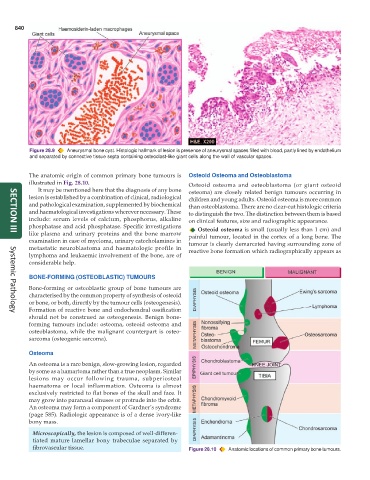
           Figure 28.9  Aneurysmal bone cyst. Histologic hallmark of lesion is presence of aneurysmal spaces filled with blood, partly lined by endothelium
           and separated by connective tissue septa containing osteoclast-like giant cells along the wall of vascular spaces.


           The anatomic origin of common primary bone tumours is  Osteoid Osteoma and Osteoblastoma
           illustrated in Fig. 28.10.                          Osteoid osteoma and osteoblastoma (or giant osteoid
              It may be mentioned here that the diagnosis of any bone  osteoma) are closely related benign tumours occurring in
           lesion is established by a combination of clinical, radiological  children and young adults. Osteoid osteoma is more common
           and pathological examination, supplemented by biochemical  than osteoblastoma. There are no clear-cut histologic criteria
           and haematological investigations wherever necessary. These  to distinguish the two. The distinction between them is based
           include: serum levels of calcium, phosphorus, alkaline  on clinical features, size and radiographic appearance.
           phosphatase and acid phosphatase. Specific investigations  Osteoid osteoma is small (usually less than 1 cm) and
           like plasma and urinary proteins and the bone marrow  painful tumour, located in the cortex of a long bone. The
     SECTION III
           examination in case of myeloma, urinary catecholamines in  tumour is clearly demarcated having surrounding zone of
           metastatic neuroblastoma and haematologic profile in  reactive bone formation which radiographically appears as
           lymphoma and leukaemic involvement of the bone, are of
           considerable help.

           BONE-FORMING (OSTEOBLASTIC) TUMOURS

           Bone-forming or osteoblastic group of bone tumours are
           characterised by the common property of synthesis of osteoid
           or bone, or both, directly by the tumour cells (osteogenesis).
           Formation of reactive bone and endochondral ossification
     Systemic Pathology
           should not be construed as osteogenesis. Benign bone-
           forming tumours include: osteoma, osteoid osteoma and
           osteoblastoma, while the malignant counterpart is osteo-
           sarcoma (osteogenic sarcoma).

           Osteoma
           An osteoma is a rare benign, slow-growing lesion, regarded
           by some as a hamartoma rather than a true neoplasm. Similar
           lesions may occur following trauma, subperiosteal
           haematoma or local inflammation. Osteoma is almost
           exclusively restricted to flat bones of the skull and face. It
           may grow into paranasal sinuses or protrude into the orbit.
           An osteoma may form a component of Gardner’s syndrome
           (page 585). Radiologic appearance is of a dense ivory-like
           bony mass.

            Microscopically, the lesion is composed of well-differen-
            tiated mature lamellar bony trabeculae separated by
            fibrovascular tissue.                              Figure 28.10  Anatomic locations of common primary bone tumours.

