


Page 861 - Textbook of Pathology, 6th Edition
P. 861
chondroid tumour with foci of haemorrhages, necrosis and  845
                                                                 calcification.
                                                                 Histologically, the tumour is highly cellular and is
                                                                 composed of small, round to polygonal mononuclear cells
                                                                 resembling chondroblasts and has multinucleate
                                                                 osteoclast-like giant cells. There are small areas of
                                                                 cartilaginous intercellular matrix and focal calcification.

                                                               Chondromyxoid Fibroma
                                                               Chondromyxoid fibroma is an uncommon benign tumour
                                                               of cartilaginous origin arising in the metaphysis of long
                                                               bones. Most common locations are upper end of tibia and
                                                               lower end of femur i.e. around the knee joint. Majority of
                                                               tumours appear in 2nd to 3rd decades of life with male
                                                               preponderance. Radiologically, the tumour appears as a
                                                               sharply-outlined radiolucent area with foci of calcification
                                                               and expansion of affected end of the bone. The lesion may
                                                               be asymptomatic, or may cause pain, swelling and discomfort
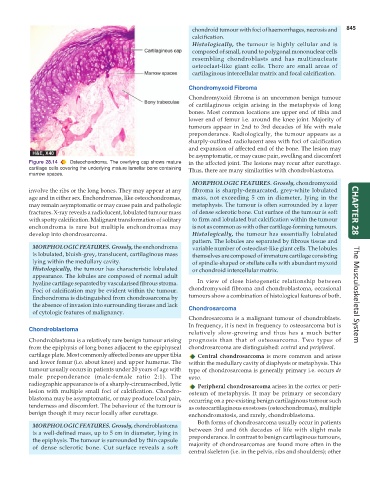
           Figure 28.14  Osteochondroma. The overlying cap shows mature  in the affected joint. The lesions may recur after curettage.
           cartilage cells covering the underlying mature lamellar bone containing  Thus, there are many similarities with chondroblastoma.
           marrow spaces.
                                                                 MORPHOLOGIC FEATURES. Grossly, chondromyxoid
           involve the ribs or the long bones. They may appear at any  fibroma is sharply-demarcated, grey-white lobulated
           age and in either sex. Enchondromas, like osteochondromas,  mass, not exceeding 5 cm in diameter, lying in the
           may remain asymptomatic or may cause pain and pathologic  metaphysis. The tumour is often surrounded by a layer
           fractures. X-ray reveals a radiolucent, lobulated tumour mass  of dense sclerotic bone. Cut surface of the tumour is soft  CHAPTER 28
           with spotty calcification. Malignant transformation of solitary  to firm and lobulated but calcification within the tumour
           enchondroma is rare but multiple enchondromas may     is not as common as with other cartilage-forming tumours.
           develop into chondrosarcoma.                          Histologically,  the tumour has essentially lobulated
                                                                 pattern. The lobules are separated by fibrous tissue and
            MORPHOLOGIC FEATURES. Grossly, the enchondroma       variable number of osteoclast-like giant cells. The lobules
            is lobulated, bluish-grey, translucent, cartilaginous mass  themselves are composed of immature cartilage consisting
            lying within the medullary cavity.                   of spindle-shaped or stellate cells with abundant myxoid
            Histologically, the tumour has characteristic lobulated  or chondroid intercellular matrix.
            appearance. The lobules are composed of normal adult
            hyaline cartilage separated by vascularised fibrous stroma.  In view of close histogenetic relationship between
            Foci of calcification may be evident within the tumour.  chondromyxoid fibroma and chondroblastoma, occasional
            Enchondroma is distinguished from chondrosarcoma by  tumours show a combination of histological features of both.  The Musculoskeletal System
            the absence of invasion into surrounding tissues and lack  Chondrosarcoma
            of cytologic features of malignancy.
                                                               Chondrosarcoma is a malignant tumour of chondroblasts.
                                                               In frequency, it is next in frequency to osteosarcoma but is
           Chondroblastoma
                                                               relatively slow-growing and thus has a much better
           Chondroblastoma is a relatively rare benign tumour arising  prognosis than that of osteosarcoma. Two types of
           from the epiphysis of long bones adjacent to the epiphyseal  chondrosarcoma are distinguished: central and peripheral.
           cartilage plate. Most commonly affected bones are upper tibia  Central chondrosarcoma is more common and arises
           and lower femur (i.e. about knee) and upper humerus. The  within the medullary cavity of diaphysis or metaphysis. This
           tumour usually occurs in patients under 20 years of age with  type of chondrosarcoma is generally primary i.e. occurs de
           male preponderance (male-female ratio 2:1). The     novo.
           radiographic appearance is of a sharply-circumscribed, lytic  Peripheral chondrosarcoma arises in the cortex or peri-
           lesion with multiple small foci of calcification. Chondro-  osteum of metaphysis. It may be primary or secondary
           blastoma may be asymptomatic, or may produce local pain,  occurring on a pre-existing benign cartilaginous tumour such
           tenderness and discomfort. The behaviour of the tumour is  as osteocartilaginous exostoses (osteochondromas), multiple
           benign though it may recur locally after curettage.  enchondromatosis, and rarely, chondroblastoma.
                                                                  Both forms of chondrosarcoma usually occur in patients
            MORPHOLOGIC FEATURES. Grossly, chondroblastoma
            is a well-defined mass, up to 5 cm in diameter, lying in  between 3rd and 6th decades of life with slight male
            the epiphysis. The tumour is surrounded by thin capsule  preponderance. In contrast to benign cartilaginous tumours,
            of dense sclerotic bone. Cut surface reveals a soft  majority of chondrosarcomas are found more often in the
                                                               central skeleton (i.e. in the pelvis, ribs and shoulders); other

