


Page 858 - Textbook of Pathology, 6th Edition
P. 858
842


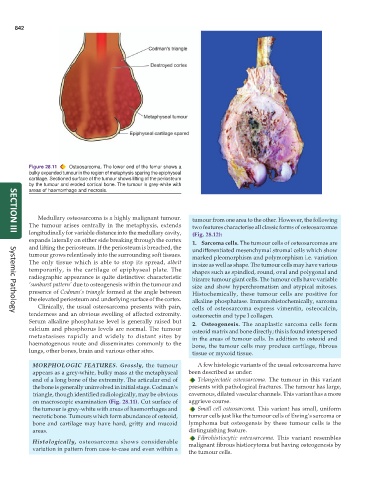
           Figure 28.11  Osteosarcoma. The lower end of the femur shows a
           bulky expanded tumour in the region of metaphysis sparing the epiphyseal
           cartilage. Sectioned surface of the tumour shows lifting of the periosteum
           by the tumour and eroded cortical bone. The tumour is grey-white with
           areas of haemorrhage and necrosis.


              Medullary osteosarcoma is a highly malignant tumour.  tumour from one area to the other. However, the following
           The tumour arises centrally in the metaphysis, extends  two features characterise all classic forms of osteosarcomas
           longitudinally for variable distance into the medullary cavity,  (Fig. 28.12):
     SECTION III
           expands laterally on either side breaking through the cortex  1. Sarcoma cells. The tumour cells of osteosarcomas are
           and lifting the periosteum. If the periosteum is breached, the  undifferentiated mesenchymal stromal cells which show
           tumour grows relentlessly into the surrounding soft tissues.  marked pleomorphism and polymorphism i.e. variation
           The only tissue which is able to stop its spread,  albeit  in size as well as shape. The tumour cells may have various
           temporarily, is the cartilage of epiphyseal plate. The  shapes such as spindled, round, oval and polygonal and
           radiographic appearance is quite distinctive: characteristic  bizarre tumour giant cells. The tumour cells have variable
           ‘sunburst pattern’ due to osteogenesis within the tumour and  size and show hyperchromatism and atypical mitoses.
           presence of Codman’s triangle formed at the angle between  Histochemically, these tumour cells are positive for
           the elevated periosteum and underlying surface of the cortex.  alkaline phosphatase. Immunohistochemically, sarcoma
              Clinically, the usual osteosarcoma presents with pain,  cells of osteosarcoma express vimentin, osteocalcin,
           tenderness and an obvious swelling of affected extremity.  osteonectin and type I collagen.
     Systemic Pathology
           Serum alkaline phosphatase level is generally raised but  2. Osteogenesis. The anaplastic sarcoma cells form
           calcium and phosphorus levels are normal. The tumour  osteoid matrix and bone directly; this is found interspersed
           metastasises rapidly and widely to distant sites by   in the areas of tumour cells. In addition to osteoid and
           haematogenous route and disseminates commonly to the  bone, the tumour cells may produce cartilage, fibrous
           lungs, other bones, brain and various other sites.    tissue or myxoid tissue.

            MORPHOLOGIC FEATURES. Grossly, the tumour             A few histologic variants of the usual osteosarcoma have
            appears as a grey-white, bulky mass at the metaphyseal  been described as under:
            end of a long bone of the extremity. The articular end of  Telangiectatic osteosarcoma. The tumour in this variant
            the bone is generally uninvolved in initial stage. Codman’s  presents with pathological fractures. The tumour has large,
            triangle, though identified radiologically, may be obvious  cavernous, dilated vascular channels. This variant has a more
            on macroscopic examination (Fig. 28.11). Cut surface of  aggrieve course.
            the tumour is grey-white with areas of haemorrhages and  Small cell osteosarcoma. This variant has small, uniform
            necrotic bone. Tumours which form abundance of osteoid,  tumour cells just like the tumour cells of Ewing’s sarcoma or
            bone and cartilage may have hard, gritty and mucoid  lymphoma but osteogensis by these tumour cells is the
            areas.                                             distinguishing feature.
                                                                  Fibrohistiocytic osteosarcoma. This variant resembles
            Histologically, osteosarcoma shows considerable    malignant fibrous histiocytoma but having osteogenesis by
            variation in pattern from case-to-case and even within a
                                                               the tumour cells.

