


Page 859 - Textbook of Pathology, 6th Edition
P. 859
843


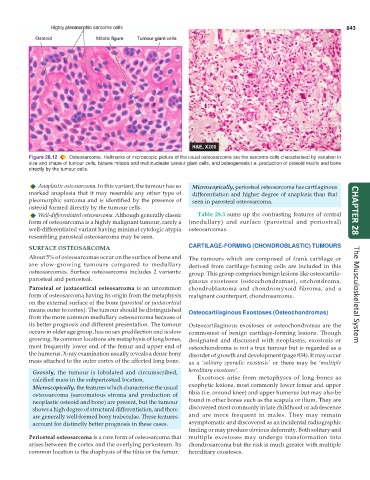
           Figure 28.12  Osteosarcoma. Hallmarks of microscopic picture of the usual osteosarcoma are the sarcoma cells characterised by variation in
           size and shape of tumour cells, bizarre mitosis and multinucleate tumour giant cells, and osteogenesis i.e. production of osteoid matrix and bone
           directly by the tumour cells.


              Anaplastic osteosarcoma. In this variant, the tumour has so  Microscopically, periosteal osteosarcoma has cartilaginous
           marked anaplasia that it may resemble any other type of  differentiation and higher degree of anaplasia than that
           pleomorphic sarcoma and is identified by the presence of  seen in parosteal osteosarcoma.
           osteoid formed directly by the tumour cells.
              Well-differentiated osteosarcoma. Although generally classic  Table 28.3 sums up the contrasting features of central  CHAPTER 28
           form of osteosarcoma is a highly malignant tumour, rarely a  (medullary) and surface (parosteal and periosteal)
           well-differentiated variant having minimal cytologic atypia  osteosarcomas.
           resembling parosteal osteosarcoma may be seen.
           SURFACE OSTEOSARCOMA                                CARTILAGE-FORMING (CHONDROBLASTIC) TUMOURS
           About 5% of osteosarcomas occur on the surface of bone and  The tumours which are composed of frank cartilage or
           are slow-growing tumours compared to medullary      derived from cartilage-forming cells are included in this
           osteosarcomas. Surface osteosarcoma includes 2 variants:  group. This group comprises benign lesions like osteocartila-
           parosteal and periosteal.                           ginous exostoses (osteochondromas), enchondroma,
           Parosteal or juxtacortical osteosarcoma is an uncommon  chondroblastoma and chondromyxoid fibroma, and a
           form of osteosarcoma having its origin from the metaphysis  malignant counterpart, chondrosarcoma.         The Musculoskeletal System
           on the external surface of the bone (parosteal or juxtacortical
           means outer to cortex). The tumour should be distinguished  Osteocartilaginous Exostoses (Osteochondromas)
           from the more common medullary osteosarcoma because of
           its better prognosis and different presentation. The tumour  Osteocartilaginous exostoses or osteochondromas are the
           occurs in older age group, has no sex predilection and is slow  commonest of benign cartilage-forming lesions. Though
           growing. Its common locations are metaphysis of long bones,  designated and discussed with neoplasms, exostosis or
           most frequently lower end of the femur and upper end of  osteochondroma is not a true tumour but is regarded as a
           the humerus. X-ray examination usually reveals a dense bony  disorder of growth and development (page 834). It may occur
           mass attached to the outer cortex of the affected long bone.  as a  ‘solitary sporadic exostosis’  or there may be  ‘multiple
            Grossly, the tumour is lobulated and circumscribed,  hereditary exostoses’.
            calcified mass in the subperiosteal location.         Exostoses arise from metaphyses of long bones as
            Microscopically, the features which characterise the usual  exophytic lesions, most commonly lower femur and upper
            osteosarcoma (sarcomatous stroma and production of  tibia (i.e. around knee) and upper humerus but may also be
            neoplastic osteoid and bone) are present, but the tumour  found in other bones such as the scapula or ilium. They are
            shows a high degree of structural differentiation, and there  discovered most commonly in late childhood or adolescence
            are generally well-formed bony trabeculae. These features  and are more frequent in males. They may remain
            account for distinctly better prognosis in these cases.  asymptomatic and discovered as an incidental radiographic
                                                               finding or may produce obvious deformity. Both solitary and
           Periosteal osteosarcoma is a rare form of osteosarcoma that  multiple exostoses may undergo transformation into
           arises between the cortex and the overlying periosteum. Its  chondrosarcoma but the risk is much greater with multiple
           common location is the diaphysis of the tibia or the femur.  hereditary exostoses.

