


Page 873 - Textbook of Pathology, 6th Edition
P. 873
857


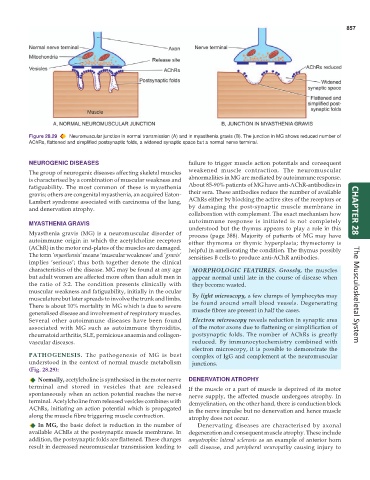
           Figure 28.29  Neuromuscular junction in normal transmission (A) and in myasthenia gravis (B). The junction in MG shows reduced number of
           AChRs, flattened and simplified postsynaptic folds, a widened synaptic space but a normal nerve terminal.


           NEUROGENIC DISEASES                                 failure to trigger muscle action potentials and consequent
           The group of neurogenic diseases affecting skeletal muscles  weakened muscle contraction. The neuromuscular
           is characterised by a combination of muscular weakness and  abnormalities in MG are mediated by autoimmune response.
           fatiguability. The most common of these is myasthenia  About 85-90% patients of MG have anti-AChR-antibodies in
           gravis; others are congenital myasthenia, an acquired Eaton-  their sera. These antibodies reduce the number of available
           Lambert syndrome associated with carcinoma of the lung,  AChRs either by blocking the active sites of the receptors or
           and denervation atrophy.                            by damaging the post-synaptic muscle membrane in
                                                               collaboration with complement. The exact mechanism how  CHAPTER 28
           MYASTHENIA GRAVIS                                   autoimmune response is initiated is not completely
                                                               understood but the thymus appears to play a role in this
           Myasthenia gravis (MG) is a neuromuscular disorder of  process (page 388). Majority of patients of MG may have
           autoimmune origin in which the acetylcholine receptors  either thymoma or thymic hyperplasia; thymectomy is
           (AChR) in the motor end-plates of the muscles are damaged.  helpful in ameliorating the condition. The thymus possibly
           The term ‘myasthenia’ means ‘muscular weakness’ and ‘gravis’  sensitises B cells to produce anti-AChR antibodies.
           implies ‘serious’; thus both together denote the clinical
           characteristics of the disease. MG may be found at any age  MORPHOLOGIC FEATURES.  Grossly, the muscles
           but adult women are affected more often than adult men in  appear normal until late in the course of disease when
           the ratio of 3:2. The condition presents clinically with  they become wasted.
           muscular weakness and fatiguability, initially in the ocular
           musculature but later spreads to involve the trunk and limbs.  By light microscopy, a few clumps of lymphocytes may  The Musculoskeletal System
           There is about 10% mortality in MG which is due to severe  be found around small blood vessels. Degenerating
           generalised disease and involvement of respiratory muscles.  muscle fibres are present in half the cases.
           Several other autoimmune diseases have been found     Electron microscopy reveals reduction in synaptic area
           associated with MG such as autoimmune thyroiditis,    of the motor axons due to flattening or simplification of
           rheumatoid arthritis, SLE, pernicious anaemia and collagen-  postsynaptic folds. The number of AChRs is greatly
           vascular diseases.                                    reduced. By immunocytochemistry combined with
                                                                 electron microscopy, it is possible to demonstrate the
           PATHOGENESIS. The pathogenesis of MG is best          complex of IgG and complement at the neuromuscular
           understood in the context of normal muscle metabolism  junctions.
           (Fig. 28.29):
              Normally, acetylcholine is synthesised in the motor nerve  DENERVATION ATROPHY
           terminal and stored in vesicles that are released   If the muscle or a part of muscle is deprived of its motor
           spontaneously when an action potential reaches the nerve  nerve supply, the affected muscle undergoes atrophy. In
           terminal. Acetylcholine from released vesicles combines with  demyelination, on the other hand, there is conduction block
           AChRs, initiating an action potential which is propagated  in the nerve impulse but no denervation and hence muscle
           along the muscle fibre triggering muscle contraction.  atrophy does not occur.
              In MG, the basic defect is reduction in the number of  Denervating diseases are characterised by axonal
           available AChRs at the postsynaptic muscle membrane. In  degeneration and consequent muscle atrophy. These include
           addition, the postsynaptic folds are flattened. These changes  amyotrophic lateral sclerosis as an example of anterior horn
           result in decreased neuromuscular transmission leading to  cell disease, and  peripheral neuropathy causing injury to

