


Page 870 - Textbook of Pathology, 6th Edition
P. 870
854 4. Renal disease involving interstitial tissue and blood  therapy, drug-induced (e.g. aspirin, pyrazinamide, nicotinic
           vessels.                                            acid, ethambutol and ethanol), adrenal insufficiency,
           5. Uric acid nephrolithiasis.                       starvation, diabetic ketosis, and disorders of parathyroid and
              The disease usually begins in 3rd decade of life and affects  thyroid. Renal disease  per se  rarely causes secondary
           men more often than women. A family history of gout is  hyperuricaemia such as in polycystic kidney disease and
           present in a fairly large proportion of cases indicating role of  leads to urate nephropathy.
           inheritance in hyperuricaemia. Clinically, the natural history
           of gout comprises 4 stages: asymptomatic hyperuricaemia,  MORPHOLOGIC FEATURES. The pathologic mani-
           acute gouty arthritis, asymptomatic intervals of intercritical  festations of gout include: acute gouty arthritis, chronic
           periods, and chronic tophaceous stage. In addition, gout  tophaceous arthritis, tophi in soft tissues, and renal lesions
           nephropathy and urate nephrolithiasis may occur (page 692).  as under:
                                                                 1. Acute gouty arthritis. This stage is characterised by
           TYPES AND PATHOGENESIS.  The fundamental bio-         acute synovitis triggered by precipitation of sufficient
           chemical hallmark of gout is hyperuricaemia. A serum uric  amount of needle-shaped crystals of monosodium urate
           acid level in excess of 7 mg/dl, which represents the upper  from serum or synovial fluid. There is joint effusion
           limit of solubility of monosodium urate in serum at 37°C at  containing numerous polymorphs, macrophages and
           blood pH, is associated with increased risk of development  microcrystals of urates. The mechanism of acute
           of gout. Thus, pathogenesis of gout is pathogenesis of hyper-  inflammation appears to include phagocytosis of crystals
           uricaemia.                                            by leucocytes, activation of the kallikrein system, activa-
              Hyperuricaemia and gout may be classified into 2 types:  tion of the complement system and urate-mediated
           metabolic and renal, each of which may be primary or secondary.  disruption of lysosomes within the leucocytes leading to
           Primary refers to cases in which the underlying biochemical  release of lysosomal products in the joint effusion. Initially,
           defect causing hyperuricaemia is not known, while secondary  there is monoarticular involvement accompanied with
           denotes cases with known causes of hyperuricaemia.
                                                                 intense pain, but later it becomes polyarticular along with
           1. Hyperuricaemia of metabolic origin. This group     constitutional symptoms like fever. Acute gouty arthritis
           comprises about 10% cases of gout which are characterised  is predominantly a disease of lower extremities, affecting
           by overproduction of uric acid. There is either an accelerated  most commonly great toe. Other joints affected, in order
           rate of purine biosynthesis de novo, or an increased turnover  of decreasing frequency, are: the instep, ankles, heels,
           of nucleic acids. The causes of primary metabolic gout include  knees, wrists, fingers and elbows.
     SECTION III
           a number of specific enzyme defects in purine metabolism  2. Chronic tophaceous arthritis. Recurrent attacks of
           which may be either of unknown cause or are inborn errors  acute gouty arthritis lead to progressive evolution into
           of metabolism. The secondary metabolic gout is due to either  chronic arthritis. The deposits of urate encrust the articular
           increased purine biosynthesis or a deficiency of glucose-6-  cartilage. There is synovial proliferation, pannus
           phosphatase.                                          formation and progressive destruction of articular
           2. Hyperuricaemia of renal origin. About 90% cases of gout  cartilage and subchondral bone. Deposits of urates in the
           are the result of reduced renal excretion of uric acid. Altered  form of tophi may be found in the periarticular tissues.
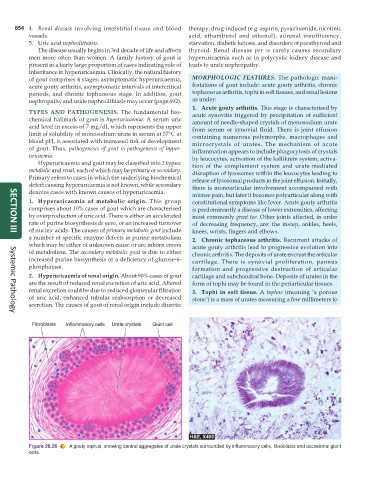
           renal excretion could be due to reduced glomerular filtration  3. Tophi in soft tissue. A tophus (meaning ‘a porous
           of uric acid, enhanced tubular reabsorption or decreased  stone’) is a mass of urates measuring a few millimeters to
           secretion. The causes of gout of renal origin include diuretic
     Systemic Pathology


           Figure 28.26  A gouty tophus, showing central aggregates of urate crystals surrounded by inflammatory cells, fibroblasts and occasional giant
           cells.

