


Page 868 - Textbook of Pathology, 6th Edition
P. 868
852                                                         Activation of macrophages releases more cytokines which
                                                               cause damage to joint tissues and vascularisation of cartilage
                                                               termed pannus formation.
                                                                  Eventually damage and destruction of bone and cartilage
                                                               are followed by  fibrosis  and  ankylosis  producing joint
                                                               deformities.
                                                                 MORPHOLOGIC FEATURES. The predominant patho-
                                                                 logic lesions are found in the joints and tendons, and less
                                                                 often, extra-articular lesions are encountered.
                                                                 ARTICULAR LESIONS. RA involves first the small joints
                                                                 of hands and feet and then symmetrically affects the joints
                                                                 of wrists, elbows, ankles and knees. The proximal
                                                                 interphalangeal and metacarpophalangeal joints are
                                                                 affected most severely. Frequently cervical spine is
                                                                 involved but lumbar spine is spared.
                                                                 Histologically, the characteristic feature is diffuse
                                                                 proliferative synovitis with formation of pannus. The
                                                                 microscopic changes are as under (Fig. 28.25):
                                                                 1. Numerous folds of large villi of synovium.
                                                                 2. Marked thickening of the synovial membrane due to
                                                                 oedema, congestion and multilayering of synoviocytes.
                                                                 3. Intense inflammatory cell infiltrate in the synovial
                                                                 membrane with predominence of lymphocytes, plasma
                                                                 cells and some macrophages, at places forming lymphoid
                                                                 follicles.
                                                                 4. Foci of fibrinoid necrosis and fibrin deposition.
                                                                    The pannus progressively destroys the underlying
     SECTION III
                                                                 cartilage and subchondral bone. This invasion of pannus
                                                                 results in demineralisation and cystic resorption of under-
                                                                 lying bone. Later, fibrous adhesions or even bony
                                                                 ankylosis may unite the two opposing joint surfaces. In
                                                                 addition, persistent inflammation causes weakening and
                                                                 even rupture of the tendons.
                                                                 EXTRA-ARTICULAR LESIONS. Nonspecific inflam-
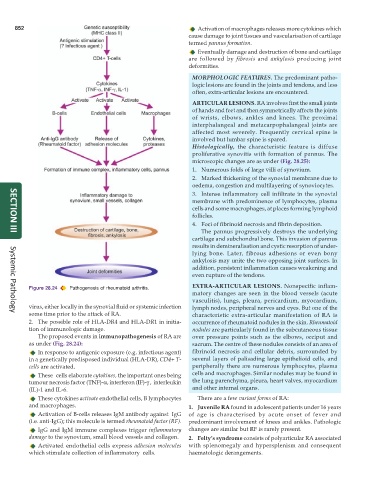
           Figure 28.24  Pathogenesis of rheumatoid arthritis.
                                                                 matory changes are seen in the blood vessels (acute
                                                                 vasculitis), lungs, pleura, pericardium, myocardium,
           virus, either locally in the synovial fluid or systemic infection  lymph nodes, peripheral nerves and eyes. But one of the
           some time prior to the attack of RA.                  characteristic extra-articular manifestation of RA is
     Systemic Pathology
           2. The possible role of HLA-DR4 and HLA-DR1 in initia-  occurrence of rheumatoid nodules in the skin. Rheumatoid
           tion of immunologic damage.                           nodules are particularly found in the subcutaneous tissue
              The proposed events in immunopathogenesis of RA are  over pressure points such as the elbows, occiput and
           as under (Fig. 28.24):                                sacrum. The centre of these nodules consists of an area of
              In response to antigenic exposure (e.g. infectious agent)  fibrinoid necrosis and cellular debris, surrounded by
           in a genetically predisposed individual (HLA-DR), CD4+ T-  several layers of palisading large epithelioid cells, and
           cells are activated.                                  peripherally there are numerous lymphocytes, plasma
              These cells elaborate cytokines, the important ones being  cells and macrophages. Similar nodules may be found in
           tumour necrosis factor (TNF)-α, interferon (IF)-γ ,  interleukin  the lung parenchyma, pleura, heart valves, myocardium
           (IL)-1 and IL-6.                                      and other internal organs.
              These cytokines activate endothelial cells, B lymphocytes  There are a few variant forms of RA:
           and macrophages.                                    1. Juvenile RA found in adolescent patients under 16 years
              Activation of B-cells releases IgM antibody against  IgG  of age is characterised by acute onset of fever and
           (i.e. anti-IgG); this molecule is termed rheumatoid factor (RF).  predominant involvement of knees and ankles. Pathologic
              IgG and IgM immune complexes trigger inflammatory  changes are similar but RF is rarely present.
           damage to the synovium, small blood vessels and collagen.  2. Felty’s syndrome consists of polyarticular RA associated
              Activated endothelial cells express adhesion molecules  with splenomegaly and hypersplenism and consequent
           which stimulate collection of inflammatory  cells.  haematologic derangements.

