


Page 869 - Textbook of Pathology, 6th Edition
P. 869
853


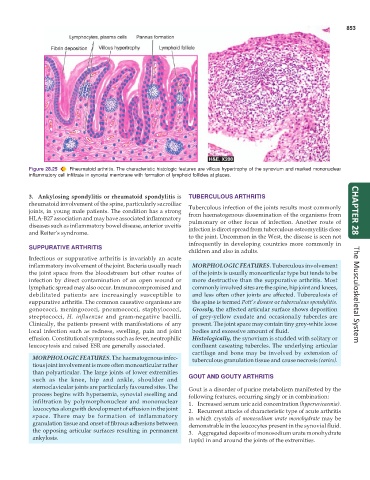
           Figure 28.25  Rheumatoid arthritis. The characteristic histologic features are villous hypertrophy of the synovium and marked mononuclear
           inflammatory cell infiltrate in synovial membrane with formation of lymphoid follicles at places.


           3. Ankylosing spondylitis or rheumatoid spondylitis is  TUBERCULOUS ARTHRITIS
           rheumatoid involvement of the spine, particularly sacroiliac  Tuberculous infection of the joints results most commonly
           joints, in young male patients. The condition has a strong  from haematogenous dissemination of the organisms from  CHAPTER 28
           HLA-B27 association and may have associated inflammatory  pulmonary or other focus of infection. Another route of
           diseases such as inflammatory bowel disease, anterior uveitis  infection is direct spread from tuberculous osteomyelitis close
           and Reiter’s syndrome.
                                                               to the joint. Uncommon in the West, the disease is seen not
                                                               infrequently in developing countries more commonly in
           SUPPURATIVE ARTHRITIS
                                                               children and also in adults.
           Infectious or suppurative arthritis is invariably an acute
           inflammatory involvement of the joint. Bacteria usually reach  MORPHOLOGIC FEATURES. Tuberculous involvement
           the joint space from the bloodstream but other routes of  of the joints is usually monoarticular type but tends to be
           infection by direct contamination of an open wound or  more destructive than the suppurative arthritis. Most
           lymphatic spread may also occur. Immunocompromised and  commonly involved sites are the spine, hip joint and knees,
           debilitated patients are increasingly susceptible to  and less often other joints are affected. Tuberculosis of  The Musculoskeletal System
           suppurative arthritis. The common causative organisms are  the spine is termed Pott’s disease or tuberculous spondylitis.
           gonococci, meningococci, pneumococci, staphylococci,  Grossly, the affected articular surface shows deposition
           streptococci,  H. influenzae and gram-negative bacilli.  of grey-yellow exudate and occasionally tubercles are
           Clinically, the patients present with manifestations of any  present. The joint space may contain tiny grey-white loose
           local infection such as redness, swelling, pain and joint  bodies and excessive amount of fluid.
           effusion. Constitutional symptoms such as fever, neutrophilic  Histologically, the synovium is studded with solitary or
           leucocytosis and raised ESR are generally associated.  confluent caseating tubercles. The underlying articular
                                                                 cartilage and bone may be involved by extension of
            MORPHOLOGIC FEATURES. The haematogenous infec-       tuberculous granulation tissue and cause necrosis (caries).
            tious joint involvement is more often monoarticular rather
            than polyarticular. The large joints of lower extremities
            such as the knee, hip and ankle, shoulder and      GOUT AND GOUTY ARTHRITIS
            sternoclavicular joints are particularly favoured sites. The  Gout is a disorder of purine metabolism manifested by the
            process begins with hyperaemia, synovial swelling and  following features, occurring singly or in combination:
            infiltration by polymorphonuclear and mononuclear  1. Increased serum uric acid concentration (hyperuricaemia).
            leucocytes alongwith development of effusion in the joint  2. Recurrent attacks of characteristic type of acute arthritis
            space. There may be formation of inflammatory      in which crystals of monosodium urate monohydrate may be
            granulation tissue and onset of fibrous adhesions between  demonstrable in the leucocytes present in the synovial fluid.
            the opposing articular surfaces resulting in permanent  3. Aggregated deposits of monosodium urate monohydrate
            ankylosis.                                         (tophi) in and around the joints of the extremities.

