


Page 117 - 9780077418427.pdf
P. 117
/Users/user-f465/Desktop
          tiL12214_ch04_085-114.indd Page 94  9/1/10  9:37 PM user-f465
          tiL12214_ch04_085-114.indd Page 94  9/1/10  9:37 PM user-f465                                                 /Users/user-f465/Desktop


                   actually a transfer of energy by working. This brings us back   Btu per hour. A much larger unit is sometimes mentioned in

                   to the definition that “energy is the ability to do work.” We can   news reports and articles about the national energy consump-
                   mentally note that this includes the ability to do work at the   tion. This unit is the quad, which is 1 quadrillion Btu (a million

                                                                                    15
                   molecular level.                                       billion or 10  Btu).
                      Heating that takes place because of a temperature diff er-  Heat is increased by an energy-form conversion, and the
                   ence will be considered in greater detail after we consider how   equivalence between energy and heating was fi rst measured

                   heat is measured.                                      by James Joule. He found that the relationship between the
                                                                          energy form (mechanical, electrical radiant, etc.) and the
                                                                          resulting heating was always the same. For example, the rela-
                   MEASURES OF HEAT
                                                                          tionship between mechanical work done and the resulting
                   Since heating is a method of energy transfer, a quantity of heat   heating is always
                   can be measured just like any quantity of energy. Th e metric
                                                                                             4.184 J = 1 cal
                   unit for measuring work, energy, or heat is the joule. However,
                   the separate historical development of the concepts of heat and                or
                   the concepts of motion resulted in separate units, some based
                                                                                             4,184 J = 1 kcal
                   on temperature diff erences.

                      The metric unit of heat is called the calorie (cal). A calorie   The establishment of this precise proportionality means that,

                   is defined as the amount of energy (or heat) needed to increase   fundamentally, mechanical work and heat are diff erent forms

                   the temperature of 1 gram of water 1 degree Celsius. A more   of the same thing.
                   precise defi nition  specifies the degree interval from 14.5°C

                   to 15.5°C  because the energy required varies slightly at dif-

                   ferent temperatures. This precise definition is not needed for   EXAMPLE 4.4

                   a general dis cussion. One kilocalorie (kcal) is the amount of   A 1,000.0 kg car is moving at 90.0 km/h (25.0 m/s). How many
                   energy (or heat) needed to increase the temperature of 1 kilogram     kilocalories are generated when the car brakes to a stop?

                   of water 1 degree Celsius. The measure of the energy released
                   by the oxidation of food is the kilocalorie, but it is called the   SOLUTION
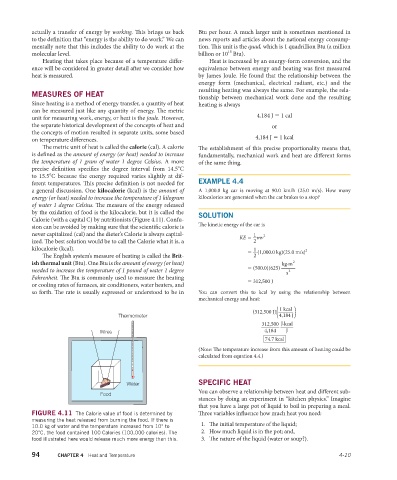
                   Calorie (with a capital C) by nutritionists (Figure 4.11). Confu-

                                                                          The kinetic energy of the car is
                   sion can be avoided by making sure that the scientific calorie is

                   never capitalized (cal) and the dieter’s Calorie is always capital-      1 _  2

                                                                                       KE =     mv


                   ized. The best solution would be to call the Calorie what it is, a       2
                   kilocalorie (kcal).                                                      1 _              2

                                                                                          =       (1,000.0 kg)(25.0 m/s)
                      The English system’s measure of heating is called the Brit-           2

                                                                                                         2
                   ish thermal unit (Btu). One Btu is the amount of energy (or heat)                 kg .  m
                                                                                                     _

                                                                                          = (500.0)(625)
                   needed to increase the temperature of 1 pound of water 1 degree                      s
                                                                                                        2

                   Fahrenheit. The Btu is commonly used to measure the heating
                                                                                          = 312,500 J
                   or cooling rates of furnaces, air conditioners, water heaters, and
                   so forth. The rate is usually expressed or understood to be in   You can convert this to kcal by using the relationship between

                                                                            mechanical energy and heat:
                                                                                                          )
                                                                                                    (
                                                                                                     1 kcal

                                                                                            (312,500 J)     _
                                               Thermometer                                           4,184 J
                                                                                               312,500 J . kcal
                                                                                               _ _


                                         Wires                                                  4,184  J
                                                                                                74.7 kcal

                                                                          (Note: The temperature increase from this amount of heating could be
                                                                          calculated from equation 4.4.)
                                                  Water                   SPECIFIC HEAT
                                                                          You can observe a relationship between heat and diff erent sub-
                                         Food
                                                                          stances by doing an experiment in “kitchen physics.” Imagine
                                                                          that you have a large pot of liquid to boil in preparing a meal.


                   FIGURE 4.11  The Calorie value of food is determined by   Three variables influence how much heat you need:
                   measuring the heat released from burning the food. If there is

                   10.0 kg of water and the temperature increased from 10° to     1.  The initial temperature of the liquid;
                   20°C, the food contained 100 Calories (100,000 calories). The     2.  How much liquid is in the pot; and,

                   food illustrated here would release much more energy than this.    3.  The nature of the liquid (water or soup?).
                   94      CHAPTER 4  Heat and Temperature                                                              4-10

