


Page 347 - 9780077418427.pdf
P. 347
/Users/user-f465/Desktop
          tiL12214_ch13_323-350.indd Page 324  9/3/10  6:14 PM user-f465
          tiL12214_ch13_323-350.indd Page 324  9/3/10  6:14 PM user-f465                                                /Users/user-f465/Desktop


                   OVERVIEW


                     The ancient alchemist dreamed of changing one element into another, such as lead into gold. The alchemist was
                     never  successful, however, because such changes were attempted with chemical reactions. Chemical reactions are
                     reactions that involve only the electrons of atoms. Electrons are shared or transferred in chemical reactions, and
                     the internal nucleus of the atom is unchanged. Elements thus retain their identity during the sharing or transferring
                     of electrons. This chapter is concerned with a different kind of reaction, one that involves the nucleus of the atom.
                     In nuclear reactions, the nucleus of the atom is often altered, changing the identity of the elements involved. The
                     ancient alchemist’s dream of changing one element into another was actually a dream of achieving a nuclear change,
                     that is, a nuclear reaction.
                         Understanding nuclear reactions is important because although fossil fuels are the major source of energy today,
                     there are growing concerns about (1) air pollution from fossil fuel combustion, (2) increasing levels of CO 2  from
                     fossil fuel combustion, which may be warming Earth (the greenhouse effect), and (3) the dwindling fossil fuel supply
                     itself, which cannot last forever. Energy experts see nuclear energy as a means of meeting rising energy demands in
                     an environmentally acceptable way. However, the topic of nuclear energy is controversial, and discussions of it often
                     result in strong emotional responses. Decisions about the use of nuclear energy require some understandings about
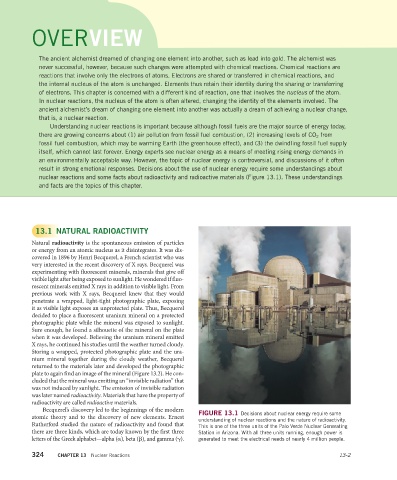
                     nuclear reactions and some facts about radioactivity and radioactive materials (Figure 13.1). These understandings
                     and facts are the topics of this chapter.


                    13.1 NATURAL RADIOACTIVITY
                   Natural radioactivity is the spontaneous emission of particles
                   or energy from an atomic nucleus as it disintegrates. It was dis-
                   covered in 1896 by Henri Becquerel, a French scientist who was
                   very interested in the recent discovery of X rays. Becquerel was
                   experimenting with fluorescent minerals, minerals that give off
                   visible light after being exposed to sunlight. He wondered if fluo-
                   rescent minerals emitted X rays in addition to visible light. From
                   previous work with X rays, Becquerel knew that they would
                   penetrate a wrapped, light-tight photographic plate, exposing
                   it as visible light exposes an unprotected plate. Thus, Becquerel
                   decided to place a fluorescent uranium mineral on a protected
                   photographic plate while the mineral was exposed to sunlight.
                   Sure enough, he found a silhouette of the mineral on the plate
                   when it was developed. Believing the uranium mineral emitted
                   X rays, he continued his studies until the weather turned cloudy.
                   Storing a wrapped, protected photographic plate and the ura-
                   nium mineral together during the cloudy weather, Becquerel
                   returned to the materials later and developed the photographic
                   plate to again find an image of the mineral (Figure 13.2). He con-
                   cluded that the mineral was emitting an “invisible radiation” that
                   was not induced by sunlight. The emission of invisible radiation
                   was later named radioactivity. Materials that have the property of
                   radioactivity are called  radioactive materials.
                      Becquerel’s discovery led to the beginnings of the modern
                                                                          FIGURE 13.1  Decisions about nuclear energy require some
                   atomic theory and to the discovery of new elements. Ernest
                                                                          understanding of nuclear reactions and the nature of radioactivity.
                   Rutherford studied the nature of radioactivity and found that   This is one of the three units of the Palo Verde Nuclear Generating
                   there are three kinds, which are today known by the first three   Station in Arizona. With all three units running, enough power is
                   letters of the Greek alphabet—alpha (α), beta (β), and gamma (γ).   generated to meet the electrical needs of nearly 4 million people.

                   324     CHAPTER 13 Nuclear Reactions                                                                  13-2

