


Page 348 - 9780077418427.pdf
P. 348
/Users/user-f465/Desktop
          tiL12214_ch13_323-350.indd Page 325  9/3/10  6:14 PM user-f465
          tiL12214_ch13_323-350.indd Page 325  9/3/10  6:14 PM user-f465                                                /Users/user-f465/Desktop


                                                                                                      γ ray
                                                                                             α particle
                                                                                                               β particle

                                                                                                                    South pole


                                                                                                                    North pole
                                                                                   Lead
                                                                                   container
                                                                                                                    Radioactive
                                                                                                                    source


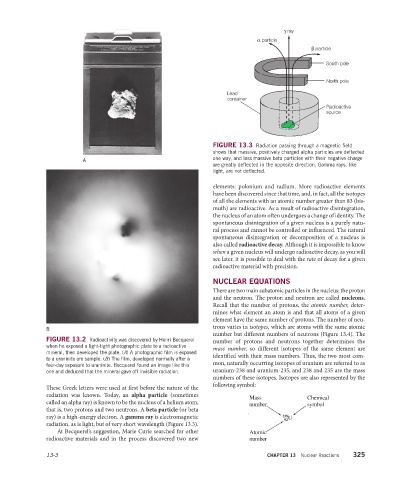
                                                                               FIGURE 13.3  Radiation passing through a magnetic field
                                                                               shows that massive, positively charged alpha particles are deflected
                                                                               one way, and less massive beta particles with their negative charge
                                    A
                                                                               are greatly deflected in the opposite direction. Gamma rays, like
                                                                               light, are not deflected.

                                                                                 elements: polonium and radium. More radioactive elements
                                                                               have been discovered since that time, and, in fact, all the isotopes
                                                                               of all the elements with an atomic number greater than 83 (bis-
                                                                               muth) are radioactive. As a result of radioactive disintegration,
                                                                               the nucleus of an atom often undergoes a change of identity. The
                                                                               spontaneous disintegration of a given nucleus is a purely natu-
                                                                               ral process and cannot be  controlled or influenced. The natural
                                                                               spontaneous disintegration or decomposition of a nucleus is
                                                                               also called radioactive  decay. Although it is impossible to know
                                                                               when a given nucleus will undergo radioactive decay, as you will
                                                                               see later, it is possible to deal with the rate of decay for a given
                                                                               radioactive material with precision.

                                                                               NUCLEAR EQUATIONS
                                                                               There are two main subatomic particles in the nucleus: the proton
                                                                               and the neutron. The proton and neutron are called nucleons.
                                                                               Recall that the number of protons, the atomic number, deter-
                                                                               mines what element an atom is and that all atoms of a given
                                                                                 element have the same number of protons. The number of neu-
                                                                               trons varies in isotopes, which are atoms with the same atomic
                       B
                                                                               number but different numbers of neutrons (Figure 13.4). The
                       FIGURE 13.2  Radioactivity was discovered by Henri Becquerel   number of protons and neutrons together determines the
                       when he exposed a light-tight photographic plate to a radioactive   mass number, so different isotopes of the same element are
                       mineral, then developed the plate. (A) A photographic film is exposed
                                                                               identified with their mass numbers. Thus, the two most com-
                       to a uraninite ore sample. (B) The film, developed normally after a
                       four-day exposure to uraninite. Becquerel found an image like this   mon, naturally occurring isotopes of uranium are referred to as
                       one and deduced that the mineral gave off invisible radiation.  uranium-238 and uranium-235, and 238 and 235 are the mass
                                                                               numbers of these isotopes. Isotopes are also represented by the
                                                                               following symbol:
                       These Greek letters were used at first before the nature of the
                       radiation was known. Today, an  alpha particle (sometimes
                       called an alpha ray) is known to be the nucleus of a helium atom,
                       that is, two protons and two neutrons. A beta particle (or beta
                       ray) is a high-energy electron. A gamma ray is electromagnetic
                       radiation, as is light, but of very short wavelength (Figure 13.3).
                           At Becquerel’s suggestion, Marie Curie searched for other
                       radioactive materials and in the process discovered two new

                       13-3                                                                      CHAPTER 13  Nuclear Reactions   325

